11 Investing Terms Every Beginner Should Know (Plain-English Guide for 2027)
Ask a room of new investors why they haven’t started yet, and many will give the same answer: “I don’t understand it.” They aren’t lazy or bad with money. They’ve simply opened a brokerage app, seen words like “expense ratio,” “asset allocation,” and “ex-dividend date,” and quietly closed it again.
Investing has its own language, and the industry doesn’t always do a good job of translating it. But you don’t need to learn hundreds of terms to make smart decisions. Most of what a beginner needs comes down to a short list of core concepts. Once you understand them, the rest of the vocabulary starts to make sense on its own.
This guide explains 11 investing terms every beginner should know in plain English, with simple examples and real-world context. For each term, you’ll see:
- What it means in one sentence
- How it works in practice
- Why it matters to your money
- Common misunderstandings to avoid
At the end, you’ll find a bonus glossary of extra terms, a section showing how all the concepts fit together, and answers to common beginner questions.
Important: This article is for general education only and is not personalized investment, tax, or legal advice. All investing involves risk, including the possible loss of principal. Examples use hypothetical numbers and assumed returns for illustration, and they are not predictions or guarantees.
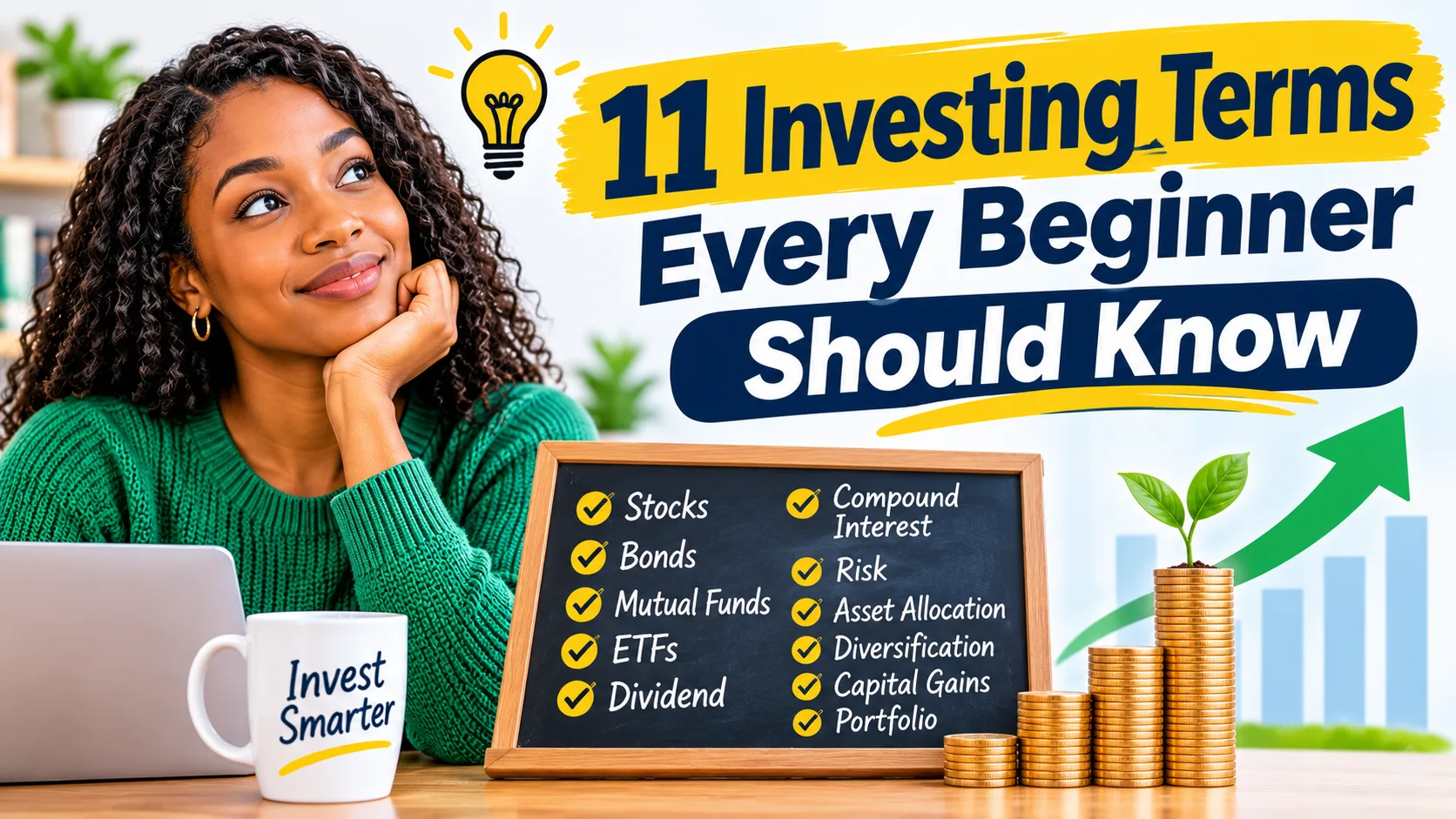
The 11 Investing Terms at a Glance
| # | Term | What It Means in One Line |
| 1 | Stock | A small piece of ownership in a company |
| 2 | Bond | A loan you make to a government or company in exchange for interest |
| 3 | Mutual fund | A pooled basket of investments managed for many investors |
| 4 | ETF | A basket of investments that trades like a stock |
| 5 | Index fund | A fund that copies a market index instead of trying to beat it |
| 6 | Diversification | Spreading your money across many investments to reduce risk |
| 7 | Asset allocation | How you divide your portfolio between stocks, bonds, cash, and more |
| 8 | Compound interest | Earning returns on your earlier returns |
| 9 | Expense ratio | The yearly fee a fund charges, as a percentage of your investment |
| 10 | Dividend | A payment some companies make to their shareholders |
| 11 | Capital gains | The profit you make when you sell an investment for more than you paid |
1. Stock (Also Called a Share or Equity)
In one sentence: A stock is a small slice of ownership in a company.
What it means
When a company wants to raise money, one way to do it is to divide ownership into millions or billions of tiny pieces called shares and sell them to the public. If you buy one share of a company, you own a very small fraction of that business. Stocks are also called equities because they represent equity, or ownership, in a company.
Stocks trade on exchanges such as the New York Stock Exchange and Nasdaq. Their prices change throughout the trading day based on supply and demand: what buyers are willing to pay and what sellers are willing to accept.
How you can make money from stocks
There are two main ways:
- Price appreciation: You buy a share at $50, the company grows, and the share eventually trades at $80. If you sell, you keep the $30 difference (before taxes).
- Dividends: Some companies share part of their profits with shareholders in regular cash payments. We’ll cover those in Term 10.
Why stock prices move
A stock’s price reflects what investors collectively believe the company is worth, based on its current earnings and its expected future earnings. Prices can move because of:
- Company news, such as earnings reports, new products, or leadership changes
- Industry trends
- Interest rates and the broader economy
- Investor mood, which is sometimes called “sentiment”
In the short term, prices can swing wildly for reasons that seem to have little to do with the underlying business. Over long periods, stock prices tend to follow how much profit companies actually generate.
Company size: “large-cap,” “mid-cap,” and “small-cap”
You’ll often see companies grouped by their market capitalization (“market cap”), which is the share price multiplied by the number of shares outstanding.
- Large-cap: Big, established companies. They’re generally (but not always) more stable.
- Mid-cap: Medium-sized companies.
- Small-cap: Smaller companies, which have more growth potential but are typically more volatile.
Why it matters to beginners
Over very long periods, stocks have historically been one of the strongest ways for ordinary people to grow wealth, and they’re the main growth engine in most retirement portfolios. They also carry real risk. A single stock can fall sharply or even go to zero. A broad collection of stocks (which we’ll get to under diversification) is much less risky than one company’s shares.
Common misunderstandings
- “A cheap share price means a bargain.” A $5 stock isn’t automatically a better deal than a $500 stock. What matters is the company’s value relative to its price, not the price tag on one share.
- “Stocks are gambling.” Buying a broad, diversified basket of stocks and holding it for years is very different from betting on a single company over a weekend. Speculating on hot tips can resemble gambling. Long-term, diversified investing doesn’t.
- “I can lose more than I invest.” If you simply buy stock with your own cash, the most you can lose is what you put in. Borrowing money to invest (“margin”) is where losses can exceed your deposit, which is a good reason for beginners to avoid it.
Quick tip
Most beginners are better off owning stocks through diversified funds than picking individual companies. If you do buy individual stocks, keep them to a small part of your portfolio.
2. Bond
In one sentence: A bond is a loan you make to a government or company in exchange for regular interest payments and the return of your money later.
What it means
When you buy a bond, you become a lender, not an owner. The issuer, which could be the U.S. Treasury, a city, or a corporation, promises to pay you interest for a set period and then give back your original investment at the end.
The key parts of a bond
- Face value (or par value): The amount you’ll be repaid at the end, often $1,000 per bond.
- Coupon rate: The annual interest rate the bond pays based on its face value. A $1,000 bond with a 5% coupon pays $50 per year.
- Maturity date: The date when the bond ends, and the issuer repays the face value.
- Issuer: The government or company that borrowed the money.
Types of bonds
- Treasury bonds, notes, and bills: Issued by the U.S. government and widely considered very low risk in terms of default.
- Municipal bonds (“munis”): Issued by states and local governments. Their interest is often exempt from federal income tax, and sometimes from state tax too.
- Corporate bonds: Issued by companies. They usually pay more than government bonds because they carry more risk.
- High-yield (“junk”) bonds: Issued by companies with weaker finances. They pay higher interest to compensate for a greater chance of default.
The most important bond rule: rates and prices move in opposite directions
This idea trips up many beginners. When interest rates rise, existing bonds that pay lower rates become less attractive, so their market prices fall. When rates fall, existing bonds paying higher rates become more valuable, so prices rise.
Here’s a simple way to think about it. Suppose you own a bond paying 3%. If newly issued bonds start paying 5%, nobody will pay full price for your 3% bond. You’d have to sell it at a discount to compete. If you hold the bond until maturity, though, you still receive your promised interest and your full face value (assuming the issuer doesn’t default).
The main risks
- Interest rate risk: Bond prices fall when rates rise, with longer-term bonds affected more.
- Credit (default) risk: The issuer may be unable to pay. Credit rating agencies grade bonds to reflect this risk.
- Inflation risk: Rising prices erode the value of fixed payments.
Why it matters to beginners
Bonds typically move less dramatically than stocks and provide steady income, so they often act as a stabilizer in a portfolio. They’re not risk-free, and they don’t always rise when stocks fall, but they can reduce overall swings. The younger you are, and the longer your horizon, the less bonds usually matter. The closer you are to needing the money, the more they tend to matter.
Common misunderstandings
- “Bonds are totally safe.” Government bonds held to maturity are very safe from default, but bond prices can still fall before maturity, and inflation can erode returns.
- “Bond funds work exactly like individual bonds.” An individual bond has a maturity date, when you get your principal back. A bond fund holds many bonds and has no single end date, so its value fluctuates continuously.
Quick tip
Most beginners get bond exposure through a broad bond index fund or a target-date fund rather than buying individual bonds.
3. Mutual Fund
In one sentence: A mutual fund pools money from many investors to buy a diversified collection of investments, managed by professionals or by a formula.
What it means
Instead of buying 500 different stocks yourself, which would be impractical and expensive, you can buy a share of a mutual fund that holds them all. Thousands of investors put money into the same fund, and the fund uses that pool to buy a broad mix of stocks, bonds, or other securities.
When you own a fund, you own a proportional slice of everything inside it. If the fund’s holdings gain value, your share rises. If they fall, your share falls.
How mutual funds are priced
Mutual funds are priced once per day, after the markets close, at their net asset value (NAV). That’s the total value of everything the fund owns, minus expenses, divided by the number of fund shares. If you place an order during the day, it’s typically executed at that day’s closing NAV.
Active vs. passive
- Actively managed funds: A professional manager and research team pick investments, aiming to beat the market. These typically charge higher fees.
- Passively managed funds (index funds): The fund simply tracks a market index. These typically charge much lower fees. We’ll cover them in Term 5.
What mutual funds invest in
- Stock funds: Invest in shares of companies.
- Bond funds: Invest in bonds.
- Balanced or hybrid funds: Hold a mix of stocks and bonds.
- Target-date funds: Automatically shift from stocks toward bonds as a chosen retirement year approaches.
- Money market funds: Hold short-term, high-quality debt and aim to keep a stable value.
Costs and details to watch
- Expense ratio: The ongoing annual fee (see Term 9).
- Sales loads: Some funds charge a commission when you buy (“front-end load”) or sell (“back-end load”). Many beginners can avoid these entirely by choosing no-load funds.
- Minimum investment: Some funds require a minimum purchase, often between $0 and $3,000, though many have no minimum at all now.
- Capital gains distributions: In taxable accounts, funds can pass taxable gains on to you even if you didn’t sell anything. Inside retirement accounts, this doesn’t matter.
Why it matters to beginners
Mutual funds are the workhorses of 401(k) plans and are one of the easiest ways to get instant diversification. If your employer offers a retirement plan, you’re probably choosing among mutual funds.
Common misunderstandings
- “Mutual funds are always safe because they’re professionally managed.” A fund holding stocks will fall when stocks fall, regardless of who runs it.
- “Higher fees mean better performance.” Research on actively managed funds has repeatedly shown that, over long periods, many fail to beat their benchmark index after fees. Higher cost doesn’t buy higher returns.
Quick tip
Look at the fund’s expense ratio, what it actually holds, and whether it charges any sales loads before buying.
4. ETF (Exchange-Traded Fund)
In one sentence: An ETF is a basket of investments that trades on a stock exchange throughout the day, just like an individual stock.
What it means
An ETF is similar to a mutual fund in what it holds: a collection of stocks, bonds, or other assets bundled together. The difference is in how you buy and sell it. You trade ETF shares on an exchange at market prices that change all day, using a brokerage account, rather than waiting for a once-daily price.
What ETFs can hold
- Broad U.S. or international stock markets
- Bonds of various types
- Specific sectors, like technology or healthcare
- Real estate (REITs)
- Commodities such as gold
- Specific themes or strategies
Why beginners like ETFs
- Low costs: Many broad-market ETFs have very low expense ratios.
- Easy access: You can buy them in any brokerage account, and many brokers let you buy fractions of a share, so you can start with a small amount.
- Transparency: ETFs typically disclose their holdings regularly.
- Tax efficiency: The way ETFs are structured often leads to fewer taxable capital gains distributions than comparable mutual funds in taxable accounts.
- Flexibility: You can buy and sell during market hours.
Terms you’ll encounter when buying an ETF
- Ticker symbol: A short code identifying the fund, such as a few capital letters.
- Market order vs. limit order: A market order buys at the best available price right now. A limit order only buys at a price you set or better. Limit orders give you more control, which is helpful with less-traded ETFs.
- Bid-ask spread: The small gap between what buyers are offering and what sellers are asking. For large, popular ETFs, this is usually tiny. For obscure ones, it can be costly.
Risks and watch-outs
- Not all ETFs are simple. Some are leveraged (designed to move at a multiple of an index’s daily performance) or inverse (designed to profit when an index falls). These are complex, often reset daily, and generally unsuitable for beginners.
- Over-trading: Because ETFs trade all day, it’s tempting to tinker. Frequent trading usually hurts returns through costs, taxes, and bad timing.
- Narrow themes: A fund focused on one trendy sector isn’t diversified, no matter how many companies it holds.
ETF vs. mutual fund: a quick comparison
| Feature | ETF | Mutual Fund |
| How it trades | On an exchange all day | Once daily at NAV |
| Minimum investment | Price of one share (or a fraction) | Often a set dollar minimum |
| Automatic investing | Depends on brokerage | Commonly available |
| Tax efficiency (taxable accounts) | Often higher | Often lower |
| Typical costs | Often very low | Varies widely |
Neither is universally better. For many beginners, the best choice is whichever offers the lowest cost and fits easily into their account.
Why it matters to beginners
ETFs make it possible to build a diversified portfolio with a few simple purchases. A single broad-market ETF can give you ownership in hundreds or thousands of companies.
Common misunderstandings
- “ETFs are a type of stock.” They trade like stocks, but they hold many investments inside.
- “All ETFs are diversified and low-risk.” Some are highly concentrated or complex. Always check what’s inside.
Quick tip
If you’re starting, stick with broad, plain-vanilla ETFs from large, reputable providers, and avoid anything you can’t explain in two sentences.
5. Index Fund
In one sentence: An index fund is a mutual fund or ETF that aims to match the performance of a market index rather than beat it.
What it means
A market index is a list of investments used to measure how a part of the market is doing. The best-known example in the U.S. is the S&P 500, which tracks about 500 of the largest publicly traded American companies. Others cover the entire U.S. market, international markets, bonds, small companies, and more.
An index fund simply buys everything in the index, in roughly the same proportions. Nobody is picking winners or trying to time the market. The fund just follows the list.
Why index funds are popular with beginners
- Instant diversification. One purchase can give you ownership in hundreds or thousands of companies.
- Low costs. Because no research team is needed, index funds can charge extremely low fees.
- Simplicity. You don’t have to analyze companies or monitor a manager.
- A strong long-term track record relative to many active funds. Studies that track fund performance over long periods have found that a majority of actively managed funds in many categories trail their benchmark index after fees. Past results don’t guarantee future ones, but the pattern has been consistent enough that index investing is widely recommended.
How an index fund works: a simple example
Imagine a tiny market with just three companies: Company A is worth $50 billion, Company B is worth $30 billion, and Company C is worth $20 billion. An index fund tracking these three would put 50% of its money in A, 30% in B, and 20% in C. If Company A grows, it automatically becomes a bigger part of the fund. This is called market-cap weighting, and it’s how most major indexes work.
Popular types of index funds
- Total U.S. stock market funds: Own most publicly traded U.S. companies.
- S&P 500 funds: Own the 500 large U.S. companies in that index.
- International stock index funds: Own companies outside the U.S.
- Total bond market funds: Own a wide mix of government and corporate bonds.
Risks and limits
- You still take market risk. If the market falls 30%, your index fund will fall roughly 30% too. Index funds reduce the risk of any single company failing, but not the risk of the market declining.
- Concentration: In some market-cap-weighted indexes, a small number of very large companies can make up a big share of the total.
- You’ll never beat the market. By design, you get the market’s return, minus a tiny fee. That’s the point, but it requires patience when you hear stories about big winners.
Why it matters to beginners
An index fund is arguably the closest thing to a default investment for long-term beginners. It removes the need to be clever, and it reduces the chances of the most common errors: picking the wrong stock, paying high fees, and trading too often.
Common misunderstandings
- “Index fund” and “ETF” are the same thing. Not quite. An index fund describes what the fund does (track an index). An ETF describes how it’s traded. There are index ETFs and index mutual funds.
- “Index funds are risk-free because they’re diversified.” Diversification reduces certain risks, but the market itself can drop.
Quick tip
When comparing index funds, check which index they track, the expense ratio, and whether the fund is large and established.
6. Diversification
In one sentence: Diversification means spreading your money across many different investments so that no single one can badly damage your overall results.
What it means
You’ve probably heard the saying, “Don’t put all your eggs in one basket.” That’s diversification in a sentence. If you own only one stock and it collapses, your portfolio collapses with it. If you own 3,000 stocks and one collapses, you barely notice.
The idea is that different investments don’t all rise and fall at the same time. When some are struggling, others may be doing better, which smooths out the overall ride.
The ways to diversify
- Across companies: Own many stocks instead of one or two.
- Across industries: Technology, healthcare, energy, consumer goods, finance, and others don’t always move together.
- Across geography: U.S. and international companies can have different growth cycles.
- Across asset classes: Stocks, bonds, cash, and real estate behave differently in different conditions.
- Across time: Investing regularly, rather than all at once, spreads your purchase prices over time. This is related to a strategy called dollar-cost averaging (see the bonus glossary).
An example of why it matters
Imagine two investors each have $10,000.
- Investor 1 puts everything into one company’s stock. The company hits a scandal, and its price drops 60%. Investor 1 now has $4,000.
- Investor 2 spreads the money evenly across 100 companies. One company drops 60%, but the other 99 are roughly unchanged. The portfolio falls by roughly 0.6%, or about $60.
The same event had dramatically different effects, based only on diversification.
What diversification can and can’t do
It can:
- Reduce the damage from any single company or sector failing
- Make your results less dependent on luck
- Help you stay calm and invested during rough patches
It can’t:
- Eliminate risk. In a broad market crash, nearly everything can fall at once.
- Guarantee profits
- Protect you if the “diversified” holdings are actually similar. Owning five different technology funds isn’t real diversification.
Signs you might not be diversified
- Most of your money is in your employer’s stock
- Your portfolio is concentrated in one hot sector or theme
- You own several funds that all hold the same top companies
- Your portfolio is entirely in one country or one asset type
The “free lunch” idea
Economists sometimes call diversification the closest thing to a “free lunch” in investing, because it can reduce risk without necessarily reducing expected returns. That doesn’t mean it’s perfect, but it’s one of the few tools that reliably helps.
Why it matters to beginners
Beginners often feel tempted to concentrate on a stock they like. Understanding diversification helps you see why a boring, broad portfolio can be a smarter foundation, with individual “fun” picks limited to a small share.
Common misunderstandings
- “More investments always means more diversification.” Number isn’t the point. Differences between holdings are.
- “Diversification guarantees I won’t lose money.” It reduces specific risks, not market-wide risk.
Quick tip
A single broad index fund or target-date fund can give you diversification across thousands of securities automatically.
7. Asset Allocation
In one sentence: Asset allocation is how you divide your portfolio among broad categories like stocks, bonds, and cash.
What it means
If diversification is about spreading money within a category, asset allocation is about deciding how much goes into each category. The main asset classes are:
- Stocks (equities): Higher growth potential, higher volatility
- Bonds (fixed income): Typically lower volatility, lower long-term growth
- Cash and cash equivalents: Savings accounts, money market funds, short-term Treasuries. These are very stable but have limited growth.
- Alternatives: Real estate, commodities such as gold, and others
Your allocation is expressed as percentages. A “60/40 portfolio,” for example, holds 60% in stocks and 40% in bonds.
Why it matters so much
Research on portfolio performance has long suggested that the split among major asset classes explains a large share of the differences in how portfolios behave over time, often more than which specific investments an investor picks. In other words, the answer to “how much in stocks versus bonds?” is among the most important decisions you’ll make.
What drives your allocation
- Time horizon: The longer until you need the money, the more risk you can usually afford to take. A 25-year-old saving for retirement has decades to recover from downturns. Someone buying a home in two years doesn’t.
- Risk tolerance: How much volatility can you handle emotionally and financially without panicking and selling?
- Goals: Growth, income, or capital preservation.
- Financial situation: Job stability, emergency savings, and other income sources all affect how much risk you can bear.
Illustrative allocations
These are for educational purposes only and aren’t recommendations.
| Style | Stocks | Bonds | Typical Fit |
| Aggressive | 80% to 100% | 0% to 20% | Long time horizon, high risk tolerance |
| Moderate | 60% to 70% | 30% to 40% | Medium horizon, balanced comfort with risk |
| Conservative | 30% to 40% | 60% to 70% | Short horizon or low risk tolerance |
You may have heard simple rules of thumb, such as holding a percentage of stocks equal to 100 minus your age. These are starting points, not laws, and they don’t account for your personal situation.
Rebalancing: keeping your allocation on track
Over time, your allocation drifts. Say you start with 70% stocks and 30% bonds, and stocks have a great year. Your mix might become 78% stocks and 22% bonds, which is riskier than you intended. Rebalancing means selling some of what has grown and buying more of what has lagged to return to your target mix.
You can rebalance:
- On a schedule, such as once a year
- When allocations drift past a threshold, such as 5 percentage points
- With new contributions, by directing new money toward the underweight asset
- Automatically, since target-date funds and many robo-advisors do it for you
Why it matters to beginners
Setting an allocation you can live with is more important than chasing the best-performing investment. A sensible allocation that you stick with through market ups and downs usually beats an aggressive one you abandon in a panic.
Common misunderstandings
- “Asset allocation is only for wealthy people.” Even a $50 monthly contribution to a target-date fund reflects an allocation decision.
- “Set it once and forget it forever.” Your allocation should evolve as your goals, timeline, and comfort with risk change.
- “Allocation and diversification are the same thing.” They’re related but distinct: allocation is how much in each category, and diversification is how widely you spread within and across them.
Quick tip
If you don’t want to manage this yourself, a target-date fund or a robo-advisor can set and maintain an allocation automatically.
8. Compound Interest (Compounding)
In one sentence: Compounding means earning returns not just on your original money but also on the returns you’ve already earned.
What it means
With simple interest, you earn the same amount every year based only on your starting balance. With compounding, each period’s earnings are added to your balance, so the next period’s earnings are calculated on a larger amount. Over time, growth builds on growth.
The same principle applies beyond savings accounts. When investments grow and you reinvest the gains or dividends, your future gains come from a bigger base. People often call it “interest on interest” or “returns on returns.”
A simple example
Say you invest $5,000 and earn 7% per year (an assumed rate for illustration only; real investment returns vary and aren’t guaranteed).
- With simple interest: You earn $350 per year. After 10 years, you’d have $5,000 + $3,500 = $8,500.
- With compound growth: After 10 years, your $5,000 would grow to roughly $9,836.
That’s about $1,336 more from compounding alone, and the gap widens dramatically the longer you stay invested.
The power of regular contributions over time
Compounding becomes more powerful when you add money regularly. Suppose you invest $300 per month and earn an assumed 7% annual return:
| Years | Total You Contributed | Approximate Balance |
| 10 | $36,000 | about $52,000 |
| 20 | $72,000 | about $156,000 |
| 30 | $108,000 | about $366,000 |
Notice what happens. Over 30 years, you’d contribute $108,000, but the balance would be more than three times that. The final decade adds far more than the first decade, even though your contribution rate didn’t change. This is why financial planners emphasize starting early.
These figures are hypothetical illustrations with a constant return. Real returns fluctuate, and some years will be negative.
The Rule of 72
A handy mental shortcut: divide 72 by the annual return rate to estimate how many years it takes your money to double. At 7%, it’s about 72 ÷ 7 ≈ 10.3 years. At 4%, it’s about 18 years. At 10%, about 7.2 years. It’s an estimate, not an exact figure, but it makes compounding tangible.
Compounding works against you with debt.
The same math that builds wealth can also build debt. Credit card balances compound too, often at high rates. A balance left unpaid can grow quickly because you’re paying interest on previous interest. That’s why paying down high-interest debt is often such a smart move before investing more aggressively.
What helps compounding work
- Starting early: Time is the most powerful variable.
- Staying invested: Withdrawing or panic-selling interrupts the process.
- Reinvesting dividends and gains: This keeps the snowball growing.
- Keeping costs low: Fees quietly shrink the base that compounds.
- Contributing consistently: Regular deposits add fuel.
Why it matters to beginners
Compounding is the reason small, steady contributions can turn into substantial sums, and the reason delaying has a real cost. It’s also the reason that avoiding unnecessary fees and not interrupting your investments matter so much.
Common misunderstandings
- “I need a lot of money to benefit.” Compounding works with any amount. Time matters more than size.
- “Returns are smooth.” Real markets don’t deliver steady 7% every year. Some years may be sharply negative, and compounding depends on staying the course through them.
- “It’s too late for me.” Starting later means less time to compound, but it’s still better than not starting.
Quick tip
Set up automatic monthly contributions and turn on dividend reinvestment. These two small moves harness compounding without requiring ongoing decisions.
9. Expense Ratio
In one sentence: The expense ratio is the annual fee a fund charges, expressed as a percentage of the money you have invested in it.
What it means
Funds aren’t free to run. They pay for management, administration, record-keeping, and other costs. Instead of sending you a bill, the fund quietly deducts these costs from the fund’s assets. The percentage deducted each year is the expense ratio.
If a fund has a 0.50% expense ratio and you have $10,000 invested, you’re effectively paying $50 per year. You won’t see a line item on a statement. The cost is simply baked into the fund’s returns.
Why a small percentage matters so much
Fees look tiny, which is why people ignore them. But they’re charged every year, regardless of whether the fund makes or loses money, and they compound against you.
Consider $10,000 invested for 30 years in two funds that earn the same assumed 7% annual return before fees:
- Fund A: Expense ratio of 0.05%. Net return is about 6.95%, so the account grows to roughly $75,000.
- Fund B: Expense ratio of 1.00%. Net return is about 6.00%, so the account grows to roughly $57,000.
The difference is around $17,500 on a single $10,000 investment, caused only by the fee gap. If you’re contributing regularly, the gap can reach tens of thousands of dollars or more.
What’s considered high or low?
This varies by fund type, but as a rough guide:
- Very low: Many broad index funds and ETFs charge well under 0.10% a year.
- Moderate: Some specialized or sector funds charge somewhere around 0.20% to 0.60%.
- High: Many actively managed funds charge 0.75% to 1% or more.
Compare funds against similar funds, since a bond index fund and an emerging markets fund can have different typical ranges.
Other costs to watch for
The expense ratio isn’t always the full picture. Also look for:
- Sales loads: Commissions when buying or selling certain mutual funds
- 12b-1 fees: Marketing and distribution fees included in some funds’ expenses
- Advisory fees: What a financial advisor or robo-advisor charges on top of fund fees
- Account fees: Some accounts, such as certain HSAs or 401(k) plans, charge administrative fees
- Trading costs: Spreads or commissions when buying and selling
- Taxes: Not a fee, but a real drag on returns in taxable accounts
Where to find it
Every fund discloses its expense ratio on its fact sheet, prospectus, and typically on your brokerage’s fund page. In a 401(k), your plan’s website should list each fund’s expense ratio.
Why it matters to beginners
Fees are one of the few parts of investing you can control. You can’t predict market returns, but you can choose low-cost funds. Over decades, the savings from lower costs can rival or exceed the effect of picking “better” investments.
Common misunderstandings
- “1% is nothing.” It can be a large share of your returns, especially when long-run returns are modest.
- “Higher fees buy better results.” Evidence generally doesn’t support that. Lower-cost funds have tended to outperform higher-cost funds in the same category over long periods, on average.
- “There are no fees because I didn’t pay anything.” Fund fees are deducted automatically. You pay them even if you never see a bill.
Quick tip
Before buying any fund, check the expense ratio and compare it with similar funds. If a fund charges much more than comparable ones, find out what you’re getting for the extra cost.
10. Dividend
In one sentence: A dividend is a payment some companies make to their shareholders out of their profits.
What it means
When a profitable company decides to share some of its earnings with owners, it pays a dividend, usually in cash and often every quarter. If you own shares, you receive a payment proportional to how many you hold.
Not every company pays dividends. Many mature, stable companies do. Many fast-growing companies prefer to reinvest profits back into the business instead.
Key dividend terms
- Dividend per share: The amount paid per share, such as $0.50 per quarter.
- Dividend yield: The annual dividend divided by the current share price. If a stock trades at $50 and pays $2 per year in dividends, its yield is 4%.
- Payout ratio: The share of profits paid out as dividends. A very high payout ratio can signal that the dividend may be hard to sustain.
- Declaration date: When the company announces the dividend.
- Ex-dividend date: To receive the upcoming dividend, you generally must own the stock before this date. If you buy on or after it, the seller keeps the payment.
- Record date and payment date: The date the company checks who owns shares, and the date the money is actually paid.
What happens to the stock price on the ex-dividend date?
The share price typically drops by roughly the amount of the dividend, because the company is handing some of its value to shareholders. This is why buying a stock just to “catch” a dividend doesn’t create free money.
Dividend reinvestment
Many brokerages offer a dividend reinvestment plan (DRIP), which automatically uses your dividend payments to buy more shares, including fractional shares. Over the long run, this feeds compounding (Term 8). Even though the dividend is reinvested, it’s generally still taxable in a regular taxable account in the year you receive it.
Dividends and taxes
In a taxable account, dividends are taxed. Qualified dividends generally receive lower tax rates, similar to long-term capital gains, if certain holding requirements are met. Ordinary (non-qualified) dividends are taxed at your regular income rates. Dividends earned inside tax-advantaged accounts such as a Roth IRA or traditional IRA aren’t taxed as they’re paid, though the rules for withdrawals depend on the account type.
Dividend funds
If you like the idea of dividends, you don’t have to pick individual stocks. Dividend-focused ETFs and mutual funds hold many dividend-paying companies at once. Some focus on high current yield, while others focus on companies with a history of raising dividends.
Risks and misunderstandings
- Dividends aren’t guaranteed. Companies can reduce or eliminate them, often when business is struggling.
- A very high yield can be a warning sign. Yield rises when the share price falls, so a yield that looks unusually generous might reflect trouble, not opportunity. This is sometimes called a “yield trap.”
- Dividends aren’t “free money.” They come out of the company’s value. A company that pays a dividend has less cash to reinvest.
- Dividend stocks aren’t necessarily safer. They can still lose value in a downturn.
- Total return is what matters. Your actual return is the dividend income plus any change in the share price. A stock paying a 5% dividend that falls 10% has still lost you money overall.
Why it matters to beginners
Dividends are a tangible way to see investments working, and they can be an important part of long-term returns, especially when reinvested. Understanding them also keeps you from chasing high yields without understanding the risks.
Quick tip
Judge dividend investments by total return and the company’s financial strength, not just the size of the yield.
11. Capital Gains
In one sentence: A capital gain is the profit you make when you sell an investment for more than you paid for it.
What it means
If you buy shares for $1,000 and later sell them for $1,500, your capital gain is $500. If you sell them for $800, you have a capital loss of $200.
The price you paid is called your cost basis. Your gain or loss is the sale price minus your cost basis.
Realized vs. unrealized
- Unrealized gain: An increase in value that exists only on paper because you haven’t sold yet. Generally, you don’t owe tax on unrealized gains.
- Realized gain: A gain locked in by selling. This is what usually triggers a tax bill in a taxable account.
Short-term vs. long-term: the one-year line
How long you held the investment before selling matters a great deal for taxes in the U.S.:
- Short-term capital gains apply to investments held for one year or less, and are taxed at ordinary income tax rates that go up to 37%.
- Long-term capital gains apply to investments held for more than a year, and are taxed at 0%, 15%, or 20% depending on your income and filing status.
Higher earners may also owe an extra 3.8% net investment income tax layered on top. The income thresholds for each rate are adjusted for inflation every year and differ by filing status, so check the current IRS figures or consult a tax professional for your situation.
The practical lesson is that holding an investment for more than a year before selling can meaningfully lower your tax bill compared to selling sooner. The holding period is counted in days, so selling a day or two too early can change the tax treatment.
A quick example
Suppose you buy a fund for $4,000 and sell it for $5,000, a $1,000 gain.
- If you sell after 8 months, the $1,000 is taxed as ordinary income, at whatever your tax bracket is.
- If you sell after 14 months, the $1,000 is taxed at the long-term rate, which is lower for most people.
Same investment, same profit, different tax outcome.
Capital losses can help.
When an investment loses value and you sell it, you realize a loss. Losses can offset gains, and if your losses exceed your gains, you can generally deduct a limited amount against other income each year (up to $3,000 for most filers), carrying the remainder forward to future years. Investors sometimes sell losers intentionally to offset gains, a strategy called tax-loss harvesting. Be aware of the wash sale rule, which disallows the loss if you buy the same or a substantially identical investment within 30 days before or after the sale.
Capital gains in funds
Even if you never sell your fund shares, a fund can sell holdings internally and distribute the resulting gains to shareholders. In a taxable account, you may owe tax on those distributions. Index funds and ETFs tend to generate fewer of these distributions than actively traded funds.
Where capital gains taxes don’t apply
Inside tax-advantaged retirement accounts, you generally don’t owe capital gains tax when you buy and sell investments within the account:
- Traditional 401(k)/IRA: Taxes are deferred until you withdraw the money.
- Roth 401(k)/Roth IRA: Qualified withdrawals are tax-free.
- HSA: Withdrawals for qualified medical expenses are tax-free.
This is one of the main reasons to use these accounts before investing in a regular taxable brokerage account.
Why it matters to beginners
Taxes can quietly eat into returns. Understanding capital gains helps you avoid unnecessary short-term sales, plan which accounts hold which investments, and keep more of what you earn.
Common misunderstandings
- “I owe tax as soon as my investment goes up.” Generally, you owe tax only when you sell (or when a fund distributes gains).
- “Reinvesting means no tax.” Reinvested dividends and distributions are still generally taxable in a regular account.
- “Losses are worthless.” Realized losses can offset gains and reduce your tax bill.
- “Capital gains tax is the same for everyone.” It depends on your holding period, income, and filing status.
Quick tip
Before selling an investment in a taxable account, check how long you’ve held it and consider the tax impact. When in doubt, consult a tax professional.
How These 11 Terms Fit Together
Individually, each term is straightforward. Together, they form a simple framework for building a portfolio.
- Start with your goals and time horizon to decide your asset allocation (Term 7): how much to hold in stocks versus bonds and cash.
- Pick the building blocks: stocks (Term 1) for growth and bonds (Term 2) for stability.
- Choose the vehicle: most beginners hold them through index funds (Term 5), packaged as mutual funds (Term 3) or ETFs (Term 4).
- Achieve diversification (Term 6) automatically, because those funds hold hundreds or thousands of securities.
- Keep costs low by comparing the expense ratio (Term 9).
- Let time work for you through compound interest (Term 8), reinvesting dividends (Term 10) and staying invested.
- Be tax-aware about capital gains (Term 11), using tax-advantaged accounts first and thinking before selling in taxable ones.
Notice how a plain-vanilla portfolio, such as a target-date fund or a handful of low-cost index funds, quietly uses all eleven concepts at once.
A worked example
Imagine a beginner named Alex, age 28, saving for retirement 35+ years away. Here’s how the terms might apply (illustrative only, not a recommendation):
- Alex chooses an aggressive asset allocation with mostly stocks and a smaller slice of bonds, because of the long horizon.
- Alex buys a total market index fund (an ETF) and a total bond index fund, giving instant diversification.
- Alex checks the expense ratios and chooses funds charging well under 0.10%.
- Alex turns on automatic monthly contributions and dividend reinvestment so compounding has the most room to work.
- Alex holds the investments in a Roth IRA and a 401(k), so capital gains taxes don’t apply to trades inside the accounts.
- Once a year, Alex rebalances back to the target mix.
That’s an entire investing plan using nothing more than the eleven terms in this guide.
Bonus Glossary: 12 More Terms Worth Knowing
Once you’ve mastered the 11 above, these additional terms will help you read financial news and account statements with confidence.
- Bull market/bear market. A bull market is a sustained period of rising prices, and a bear market is generally defined as a drop of 20% or more from a recent peak. Both are normal parts of the market cycle.
- Volatility. How much and how quickly an investment’s price moves up and down. Higher volatility means a bumpier ride.
- Liquidity. How quickly you can turn an investment into cash without losing much value. Savings accounts and large-company stocks are highly liquid. Real estate and some private investments are not.
- Dollar-cost averaging (DCA). Investing a fixed dollar amount at regular intervals, regardless of price. It reduces the pressure to time the market and builds consistent habits, though it doesn’t guarantee profits or prevent losses.
- Rebalancing. Adjusting your portfolio back to its target allocation after market movements have shifted it.
- Risk tolerance. Your ability and willingness to endure investment losses without abandoning your plan.
- Inflation. The general rise in prices over time, which erodes purchasing power. Investments need to grow faster than inflation to increase your real wealth.
- Brokerage account. An account that lets you buy and sell investments such as stocks, bonds, ETFs, and mutual funds.
- Roth IRA / traditional IRA / 401(k). Tax-advantaged retirement accounts. Contributions to traditional accounts are typically tax-deductible with taxes due on withdrawal, while Roth contributions are made with after-tax money and qualified withdrawals are tax-free. Annual contribution limits apply.
- Employer match. Money your employer contributes to your retirement plan based on your own contributions, effectively an instant return on your investment.
- Market order vs. limit order. A market order executes immediately at the best available price. A limit order executes only at your specified price or better.
- Fiduciary. A professional legally obligated to act in your best interest. When hiring an advisor, ask whether they’re a fiduciary and how they’re paid.
7 Beginner Mistakes These Terms Can Help You Avoid
- Putting all your money into one stock. Diversification (Term 6) protects you.
- Ignoring fees. The expense ratio (Term 9) is a small number with large long-term effects.
- Chasing high dividend yields. Check sustainability and total return (Term 10).
- Selling too early and paying extra tax. Understand short-term versus long-term capital gains (Term 11).
- Holding an allocation that doesn’t match your timeline. Revisit your asset allocation (Term 7).
- Waiting to start. Compounding (Term 8) rewards early action.
- Buying funds without knowing what’s inside. Look at what a mutual fund, ETF, or index fund actually holds (Terms 3 to 5).
Frequently Asked Questions
What are the most important investing terms for beginners?
The core terms are stocks, bonds, mutual funds, ETFs, index funds, diversification, asset allocation, compound interest, expense ratio, dividends, and capital gains. Together they cover what you buy, how you hold it, how it grows, what it costs, and how it’s taxed.
What’s the difference between a stock and a bond?
A stock represents ownership in a company, and its value rises and falls with the company’s fortunes. A bond is a loan to a company or government that pays interest and returns your principal at maturity. Stocks usually offer more growth potential and more volatility, while bonds usually offer more stability and income.
What’s the difference between an ETF and a mutual fund?
Both hold baskets of investments. An ETF trades on an exchange throughout the day like a stock, while a mutual fund is priced once a day after the market closes. Many ETFs also tend to be more tax-efficient in taxable accounts, though both can be excellent, low-cost choices.
Is an index fund an ETF?
Not necessarily. “Index fund” describes what the fund does: it tracks an index. It can be structured as either an ETF or a mutual fund.
What is a good expense ratio?
Lower is generally better. Many broad index funds and ETFs charge well under 0.10% annually. Compare a fund with similar funds, and be cautious about paying significantly more without a clear reason.
How does compound interest work in investing?
Your returns generate their own returns when you leave them invested or reinvest them. Over long periods, this snowball effect can produce much larger balances than the money you contributed, which is why time in the market is so valuable.
How is diversification different from asset allocation?
Asset allocation is deciding how much to put in each major category, such as stocks, bonds, and cash. Diversification is spreading your money widely within and across those categories. You need both.
Do I pay taxes on investments if I don’t sell?
Generally, you don’t owe tax on unrealized gains. But you may owe tax on dividends and fund distributions received during the year in a taxable account, even if you didn’t sell anything. Retirement accounts have different rules.
How long do I need to hold an investment for lower capital gains tax rates?
In the U.S., you generally need to hold it for more than one year to qualify for the lower long-term rates. Always confirm the current rules and thresholds with the IRS or a tax professional.
Can I lose all my money in investing?
It’s possible to lose money in any investment other than insured deposits, and individual stocks can lose all their value. Diversified funds are far less likely to go to zero, but they can still decline significantly in downturns. Matching your investments to your time horizon and risk tolerance helps manage that risk.
Do I need a lot of money to start investing?
No. Many brokerages have no account minimums, and fractional shares let you invest small amounts. Starting small and staying consistent is more important than starting big.
Should I hire a financial advisor?
Not every beginner needs one, but an advisor can help with complex situations. If you hire one, look for a fiduciary and understand exactly how they’re compensated.
Final Thoughts: Vocabulary Is the First Step to Confidence
Investing can seem intimidating, but much of that fear comes from the unfamiliar words. Once you understand these 11 terms, you can read an account statement, compare two funds, and spot a bad deal with far greater confidence.
To recap:
- Stocks make you an owner, and bonds make you a lender.
- Mutual funds, ETFs, and index funds let you hold many investments at once.
- Diversification and asset allocation manage risk.
- Compound interest rewards time and consistency.
- Expense ratios quietly shape your long-term results.
- Dividends and capital gains describe how your investments pay you and how taxes enter the picture.
You don’t need to master every term overnight. Start with the basics, begin investing in a simple, diversified, low-cost way, and let your understanding grow as your portfolio does. The investors who do best over time are usually not the ones with the fanciest vocabulary. They’re the ones who start early, keep costs low, stay diversified, and stay the course.
I can also create a printable one-page glossary, a social-media carousel breakdown of the 11 terms, or a follow-up article such as “15 More Investing Terms Intermediate Investors Should Know.”