Good Debt vs. Bad Debt: When Borrowing Works for You vs. Against You
Target Keywords: good debt vs bad debt, what is good debt, what is bad debt, when borrowing is smart, types of debt, good debt examples, bad debt examples, how to manage debt, borrowing money wisely, debt strategy
Introduction: Not All Debt Is Created Equal
Mention the word “debt” in any financial conversation, and most people will immediately flinch. We are conditioned — by parents, religious teachings, financial gurus, and painful personal experience — to see debt as inherently dangerous, morally suspect, and financially destructive. “Stay out of debt” is perhaps the most universally dispensed piece of financial advice in the world.
But here is the truth that separates financially sophisticated people from the rest: not all debt is the same. Debt is not simply a four-letter word. It is a financial tool — and like any tool, its value depends entirely on how, when, and why it is used.
The world’s wealthiest individuals and most successful businesses use debt strategically, deliberately, and often aggressively. Real estate empires are built with borrowed money. Multinational corporations issue bonds worth billions to finance expansion. Governments borrow to build roads, schools, and infrastructure that generate long-term economic value. When used correctly, debt can be one of the most powerful wealth-building instruments available.
On the other hand, consumer debt used to fund depreciating purchases, lifestyle inflation, or short-term impulse gratification can devastate families, destroy credit scores, and lock individuals into the debt cycle for decades.
The key, then, is not to avoid all debt — it is to understand the difference between good debt and bad debt, and to make borrowing decisions that serve your financial future rather than undermine it.
This comprehensive guide will walk you through everything you need to know: what good and bad debt are, how to tell the difference, real-world examples of each, how context and interest rates change the equation, and how to build a borrowing strategy that works for your life and goals.
Defining Good Debt: Borrowing That Builds
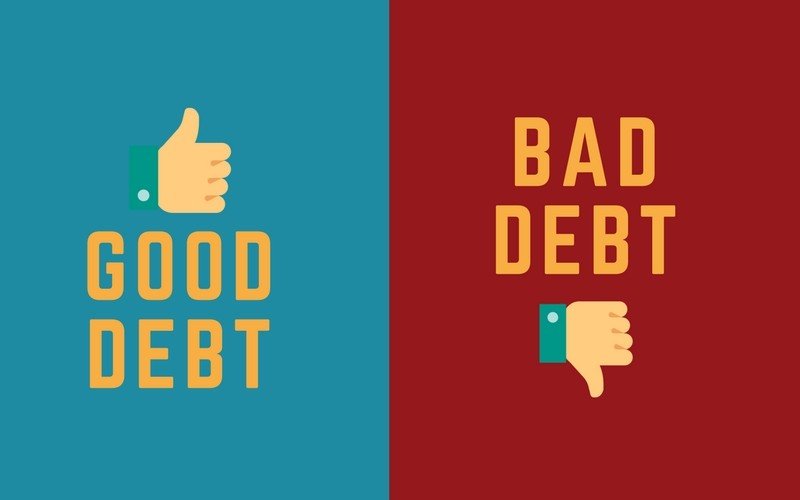
Good debt, in its simplest definition, is debt that is used to acquire something that increases in value over time or generates income that exceeds the cost of the debt itself. It is borrowed money that, when deployed wisely, puts you in a better financial position than if you had never borrowed at all.
Think of good debt as an investment with a borrowed instrument. The borrowed capital enables you to acquire an asset, build a skill, or create a cash flow that grows your net worth, increases your earning power, or generates returns that outpace the interest you are paying on the loan.
Good debt typically has the following characteristics:
- A relatively low interest rate, which keeps the cost of borrowing manageable
- A clear and productive purpose, such as acquiring an asset, investing in education, or building a business
- A tangible return on investment, whether through increased income, appreciating asset value, or long-term cost savings
- A structured and manageable repayment schedule that fits within your budget without causing financial distress
- The potential to improve your net worth over the life of the loan, even after repayment costs are factored in
Good debt works for you. It creates future value that justifies the present cost.
Defining Bad Debt: Borrowing That Burdens
Bad debt is the opposite. It is borrowed money used to purchase things that decline in value over time, provide no long-term financial return, or fund a lifestyle that income alone cannot sustain. Bad debt enriches lenders at the expense of borrowers, often trapping them in cycles of minimum payments, escalating interest charges, and diminishing financial capacity.
Bad debt typically has these characteristics:
- A high interest rate, often exceeding 20–30% annually or more
- No productive purpose, funding consumption rather than investment
- A depreciating or disappearing asset — or no asset at all
- A psychological rather than financial driver, such as status, impulse, or social pressure
- A net negative effect on your financial position over time
Bad debt works against you. It drains future wealth to pay for present consumption.
Examples of Good Debt
To make the distinction concrete, let us explore the most widely recognized categories of good debt — and importantly, the conditions under which they remain “good.”
1. Mortgage Loans for Property Acquisition
A mortgage used to purchase real estate is the most classic example of good debt. Property, in most markets and over most time periods, appreciates. The home or land you purchase today with a mortgage is typically worth more in 10, 20, or 30 years than it costs you today.
Beyond appreciation, a home provides shelter — a basic necessity — that would otherwise have to be paid for through rent. In many cases, a mortgage payment is comparable to or even lower than rental costs for a similar property, meaning the borrower is building equity (ownership stake) while spending a similar amount they would spend renting.
For investors, mortgage debt used to acquire income-generating property (rental properties, commercial real estate) is particularly powerful. The rental income covers the mortgage payment and ideally generates surplus cash flow, while the property itself appreciates — a dual return on a single leveraged investment.
When it becomes bad: A mortgage becomes bad debt when the property is purchased above market value, when the interest rate is excessively high, when the borrower over-extends beyond what they can sustainably repay, or when the property is acquired in a declining market without adequate research.
2. Student Loans and Educational Investment
Education, broadly speaking, is an investment in human capital — your ability to generate income over the course of your career. A degree, professional certification, or vocational training that increases your earning potential by more than it costs is, by the numbers, good debt.
A medical student who takes on significant loan debt to complete their training will, assuming they complete their education and enter the profession, earn multiples of the loan cost over the course of their career. A student who borrows to earn an engineering degree, an accountancy qualification, or a legal education in a growing market is investing in a documented income-producing asset: their professional credentials.
Similarly, in the Nigerian and broader African context, borrowing to fund professional certifications, technical skills training, or entrepreneurship programs that demonstrably increase earning capacity qualifies as productive educational investment.
When it becomes bad: Educational debt becomes bad debt when the degree or program does not demonstrably increase earning power, when the cost of education vastly outweighs the expected income benefit, when the field has limited job prospects, or when the borrower drops out without completing the qualification. Borrowing ₦2 million to study for a degree in a field that pays ₦80,000 per month after graduation is not an investment — it is a burden.
3. Business Loans for Income-Generating Ventures
Debt used to start or grow a legitimate, viable business can be powerfully wealth-creating. A business loan used to purchase income-generating equipment, expand production capacity, hire staff who drive revenue growth, or enter a new market can generate returns that far exceed the cost of the borrowed capital.
Consider a small trader who borrows to purchase inventory at wholesale prices for resale. The profit margin on the inventory, multiplied across the volume enabled by the loan, easily covers the loan repayment and still yields a net profit. The debt has been used as leverage to multiply the trader’s productive capacity.
The same logic applies to larger businesses: borrowing to buy machinery that increases output, to open a second location that generates new revenue, or to fund a product launch into an underserved market can all be justified as good debt when the projections are realistic, and the business fundamentals are sound.
When it becomes bad: Business debt becomes bad debt when the business model is flawed, when loans are used to cover operating losses rather than fuel growth, when the entrepreneur borrows against personal assets without a credible repayment plan, or when market research is inadequate, and revenue projections are overly optimistic.
4. Low-Interest Loans for Asset-Building
Some financial products — vehicle financing for commercial use, equipment loans, certain government-subsidized credit facilities — offer interest rates low enough that the productive use of the asset purchased justifies the borrowing cost. A delivery driver who takes a low-interest vehicle loan to purchase a car used in a logistics business is converting debt into income-producing capacity.
In economies where savings are eroded by inflation, low-interest debt can sometimes be a rational tool for acquiring assets that hold or grow in value faster than the cost of the loan. This requires careful calculation, but the principle is sound.
Examples of Bad Debt
Now, let us turn to the forms of debt that most commonly trap individuals in cycles of financial distress.
1. High-Interest Credit Card Debt for Consumer Spending
Credit card debt used to fund routine consumption — groceries, restaurant meals, entertainment, clothing, travel — is the archetype of bad debt. The purchases made are consumed or depreciate immediately, leaving no lasting asset, while the unpaid balance accrues interest at rates that can range from 18% to over 40% annually, depending on the card and the country.
The minimum payment trap is particularly insidious. When a credit card balance of ₦200,000 is carried at 25% annual interest, and only the minimum payment is made each month, the borrower could spend years — potentially over a decade — paying off that balance, ultimately repaying two or three times the original amount borrowed.
For every ₦100 you spend on a credit card and carry unpaid for a year at 25% interest, you are actually spending ₦125. For 10 years of minimum payments, that ₦100 purchase could effectively cost ₦200 or more. The item purchased — a dinner, a piece of clothing, a weekend getaway — is long gone. The debt remains.
2. Payday Loans and High-Interest Emergency Borrowing
Payday loans and their equivalents — often marketed as “quick cash,” “emergency funds,” or “soft loans” — represent some of the most damaging financial products available. With effective annual interest rates that can exceed 300–400% in some markets, these instruments are designed around the mathematical certainty that many borrowers will be unable to repay on the original terms.
In Nigeria and many African markets, informal lenders, digital loan apps, and certain microfinance products charge daily or weekly interest rates that appear small but compound catastrophically. A borrower who takes ₦50,000 at 10% monthly interest to cover a rent shortfall must repay ₦55,000 in 30 days. If they cannot, the ₦55,000 becomes the new principal, and another 10% is charged. Within six months, the debt has grown to nearly ₦90,000 — nearly double the original amount, without a single naira borrowed additionally.
These instruments are rarely used for investment. They are used for survival — paying rent, buying food, covering utility bills. The borrowed money is immediately consumed, leaving no assets. The debt, however, grows.
3. Auto Loans for Luxury or Lifestyle Vehicles
A vehicle loan, depending on how it is used, can be good or bad debt. A commercial vehicle used in business is good debt (discussed earlier). A luxury car purchased primarily for status or lifestyle enhancement, financed at high interest rates, is bad debt.
Cars depreciate rapidly — most lose 20–30% of their value within the first year of ownership. A vehicle that costs ₦15 million and is financed at 18% interest will cost the borrower several million naira in interest over the loan period, while the car itself loses significant value. By the time the loan is repaid, the car may be worth a fraction of what was paid for it — including interest.
The borrower has spent years making payments for an asset that diminished in value throughout the entire repayment period. That is the definition of bad debt.
The exception: If a vehicle is essential for income generation — a rideshare driver, a delivery business, a sales representative who cannot work without reliable transportation — the calculus changes. The vehicle enables income, and the loan can be justified.
4. Borrowing for Vacations, Weddings, and Celebrations
Across cultures, there is immense social pressure to spend lavishly on milestone events — weddings, naming ceremonies, funerals, birthdays, and other celebrations. In many Nigerian communities, the social expectations around these events are particularly intense, and families often take on significant debt to meet them.
Borrowing to fund a celebration is bad debt in its clearest form. A wedding that costs ₦3 million, financed with personal loans at high interest rates, starts a marriage in financial deficit. The event — however beautiful and memorable — is over in a day. The debt can last for years. The couple begins their life together not with a financial foundation but with a financial burden.
The same applies to luxury vacations, expensive electronics purchased on credit, or any other high-cost experience or depreciating item funded with borrowed money. The memories are real. The debt is equally real — and more lasting.
5. Using Debt to Fund Other Debt
One of the most dangerous debt behaviours is using new borrowing to pay off existing debt without a coherent restructuring plan. Taking a personal loan to pay a credit card bill, then spending on the card again, results in both the loan and a new credit card balance — a deeper, more complex debt situation than before.
Similarly, rolling over unpaid loans, deferring interest, or taking new informal loans to meet the obligations of existing ones is a spiral that typically ends in financial collapse. Each iteration adds cost (new fees, new interest) without reducing the underlying principal.
This is not debt management — it is debt avoidance, and it always makes the situation worse.
The Gray Zone: When Good Debt Turns Bad
The line between good debt and bad debt is not always fixed. Several factors can convert ostensibly productive borrowing into a destructive burden.
Interest Rate Changes
A mortgage taken at a comfortable fixed rate is manageable. The same mortgage at an adjustable rate that rises significantly — as happened to millions during global interest rate hikes — can become crushing. The terms of a loan matter as much as its purpose.
Over-Leveraging
Borrowing more than you can comfortably repay — even for genuinely productive purposes — introduces fragility. A business loan that exceeds the cash flow capacity of the business, even if the underlying purpose is sound, creates a situation where a single bad month can trigger default and cascading consequences.
Economic Environment Changes
Good debt is underwritten by assumptions about the future: that the business will generate revenue, that the property market will hold or grow, and that the degree will lead to employment. When those assumptions are invalidated by economic shifts — recessions, market collapses, industry disruption, pandemics — good debt can become unserviceable.
Personal Circumstances
Job loss, illness, divorce, or other life events can transform serviceable debt into a catastrophic burden, regardless of why it was originally taken. This is why financial resilience — emergency funds, adequate insurance, income diversification — is as important as the quality of the debt itself.
How to Evaluate Any Borrowing Decision
Before taking on any debt, ask yourself these critical questions:
- What is this debt for? Identify the specific purpose. Is it for an asset that will appreciate or generate income? Is it to fund consumption or status? The purpose is the first determinant of whether debt is productive or destructive.
- What is the total cost of borrowing? Calculate not just the monthly payment but the total amount you will repay over the life of the loan, including all interest and fees. The difference between what you borrow and what you repay is the true cost of that debt.
- What is the return on this investment? For productive debt, estimate what the borrowed capital will generate. A business loan should generate a return that exceeds its cost. An education loan should increase lifetime earnings by more than the total loan cost. Property should appreciate or generate rental income. If there is no quantifiable return, the debt is almost certainly bad.
- Can you comfortably afford the repayments? Debt repayments should ideally not exceed 30–35% of your take-home income. Anything higher creates financial fragility where an unexpected event can trigger default.
- What is the interest rate relative to expected returns? If you are borrowing at 20% and the investment returns 15%, you are losing money. The return on debt-funded investments must exceed the cost of the debt, or you are destroying value.
- What is your exit strategy if circumstances change? For large debts, think about what happens if income drops, markets shift, or the investment underperforms. Is there a plan? Can the debt be restructured or repaid from another source?
- Is there an alternative to borrowing? Could you save for a shorter period and purchase without debt? Could you start smaller and scale with earnings rather than loans? Sometimes the best borrowing decision is not to borrow at all.
Interest Rates: The Most Important Variable in the Good vs. Bad Equation
Perhaps no single factor matters more in determining whether debt is good or bad than the interest rate. Interest rate is the price of money — what you pay for the privilege of using borrowed capital.
Low-interest debt (typically below 10% for personal loans, lower for mortgages) keeps the cost of borrowing manageable, giving productive investments a realistic opportunity to generate returns that exceed borrowing costs.
High-interest debt (anything above 20% annually, and dramatically so for payday or informal loans) creates a mathematical headwind that most productive activities cannot overcome. Even sound businesses struggle to generate consistent returns above 40% annually, the rates at which many high-cost lenders operate. Against these rates, almost any borrowing purpose becomes bad debt.
In Nigeria, where formal bank lending rates can range from 18–30%, and informal lending rates can be far higher, this calculation is especially important. Borrowers must be acutely aware that the higher the interest rate, the higher the bar for a return that justifies the debt.
Building a Smart Debt Strategy
A sophisticated approach to personal or business finance does not avoid all debt. It uses debt selectively, intentionally, and within a clear strategic framework.
Principle 1: Maximize good debt opportunities. If you have access to low-interest credit for genuinely productive purposes — buying property in a growing market, investing in skills that increase income, financing a profitable business expansion — consider using it strategically rather than avoiding debt categorically.
Principle 2: Eliminate bad debt aggressively. High-interest consumer debt should be treated as a financial emergency. Every extra naira or dollar beyond minimum payments directed at bad debt is a guaranteed return equal to the interest rate of that debt — often 25% or more. Few investments offer that certainty.
Principle 3: Separate your financing by purpose. Never mix productive borrowing with consumer borrowing. A business line of credit should only ever be used for business. A property loan is for property. Mixing purposes blurs accountability and makes it impossible to accurately measure the return on borrowed capital.
Principle 4: Keep total debt-to-income within safe limits. Most financial advisors recommend keeping total monthly debt obligations below 35–40% of gross monthly income. This buffer preserves financial flexibility and reduces the risk of a single shock causing default.
Principle 5: Refinance strategically. If you carry debt at high interest rates and your credit has improved, explore refinancing to lower rates. Even a 5% reduction in interest rate on a significant balance can save enormous amounts over the life of the loan.
Principle 6: Build assets alongside debt. The healthiest financial positions combine productive debt with growing assets. Borrowing for investment while simultaneously building an emergency fund, contributing to a pension, or building other asset classes creates resilience and long-term wealth.
Good Debt vs. Bad Debt in the Nigerian and African Context
For readers in Nigeria and across Africa, the good debt vs. bad debt framework takes on particular nuance given the economic environment.
Inflation and currency pressure: In high-inflation environments, borrowing to acquire hard assets — real estate, equipment, productive inventory — can be a rational inflation hedge, provided borrowing costs are lower than the rate of asset appreciation. At the same time, high-interest naira-denominated loans make many borrowing propositions unfeasible.
Cooperative and community financing (Ajo/Esusu): Rotating savings and credit associations are a traditional and powerful form of low-cost lending within African communities. Used to fund productive investments, these are excellent examples of low-cost, relationship-based good debt.
SME and entrepreneurial borrowing: For the large proportion of Nigerians who are self-employed or run small businesses, business loans can be powerfully productive — but require discipline, financial literacy, and realistic cash flow projections. Many SME loans turn bad not because the purpose was wrong but because the financial management was inadequate.
Lifestyle and social spending debt: Social pressure to spend on celebrations, to display status through consumer goods, or to fund a lifestyle above means is a significant driver of bad debt in Nigerian households. Recognizing and resisting this pressure is not cultural rejection — it is financial survival.
Conclusion: Borrow with Purpose, Repay with Discipline
The question is never simply whether to borrow. The question is whether, at this interest rate, for this purpose, at this time, with this plan, the debt will serve your financial future or undermine it.
Good debt is a lever — it amplifies productive effort and accelerates wealth creation. Bad debt is a drain — it transfers your future wealth to lenders in exchange for present consumption or false comfort.
Financial sophistication is not about living debt-free at all costs. It is about understanding debt clearly enough to use it as the powerful instrument it can be, while avoiding the forms of it that silently erode financial health over years and decades.
Borrow with purpose. Invest with discipline. Repay with commitment. And always, always ask: Is this debt working for me, or am I working for this debt?
The answer to that question could be the difference between financial freedom and a lifetime of financial servitude.
Frequently Asked Questions (FAQ)
What is the main difference between good debt and bad debt? Good debt is used to acquire appreciating assets or generate income that exceeds the cost of borrowing. Bad debt funds consumption or depreciating purchases with no financial return, typically at high interest rates.
Is a mortgage always considered good debt? Generally, yes, but not always. A mortgage on a fairly priced, appreciating property at a manageable interest rate is good debt. A mortgage taken at high cost, on an overpriced property, or beyond the borrower’s repayment capacity can become bad debt.
Are student loans good debt or bad debt? It depends on the degree, the cost, and the resulting earning potential. Educational debt that meaningfully increases career earnings is good. Expensive degrees in low-paying fields with poor employment prospects can be bad debt.
How do I convert bad debt into good debt? You cannot directly convert bad debt into good debt, but you can eliminate bad debt through aggressive repayment strategies (avalanche or snowball methods), debt consolidation at lower interest rates, and behavioural changes that prevent new bad debt from accumulating.
What interest rate separates good debt from bad debt? There is no universal threshold, but generally, debt below 10% annual interest for productive purposes is manageable, good debt, while debt above 20% — especially for consumer spending — is likely bad debt. The key is always whether the return on borrowed capital exceeds the cost.
Can business debt be bad debt? Absolutely. Business debt becomes bad debt when used to sustain unprofitable operations, when interest costs exceed business returns, or when personal assets are placed at unreasonable risk for a fundamentally flawed business model.
How much debt is too much? Most financial advisors recommend keeping total monthly debt payments below 35–40% of gross monthly income. Beyond this level, financial flexibility is severely compromised, and the risk of default rises significantly.
In another related article, How to Consolidate Credit Card Debt & Lower Your Monthly Payments