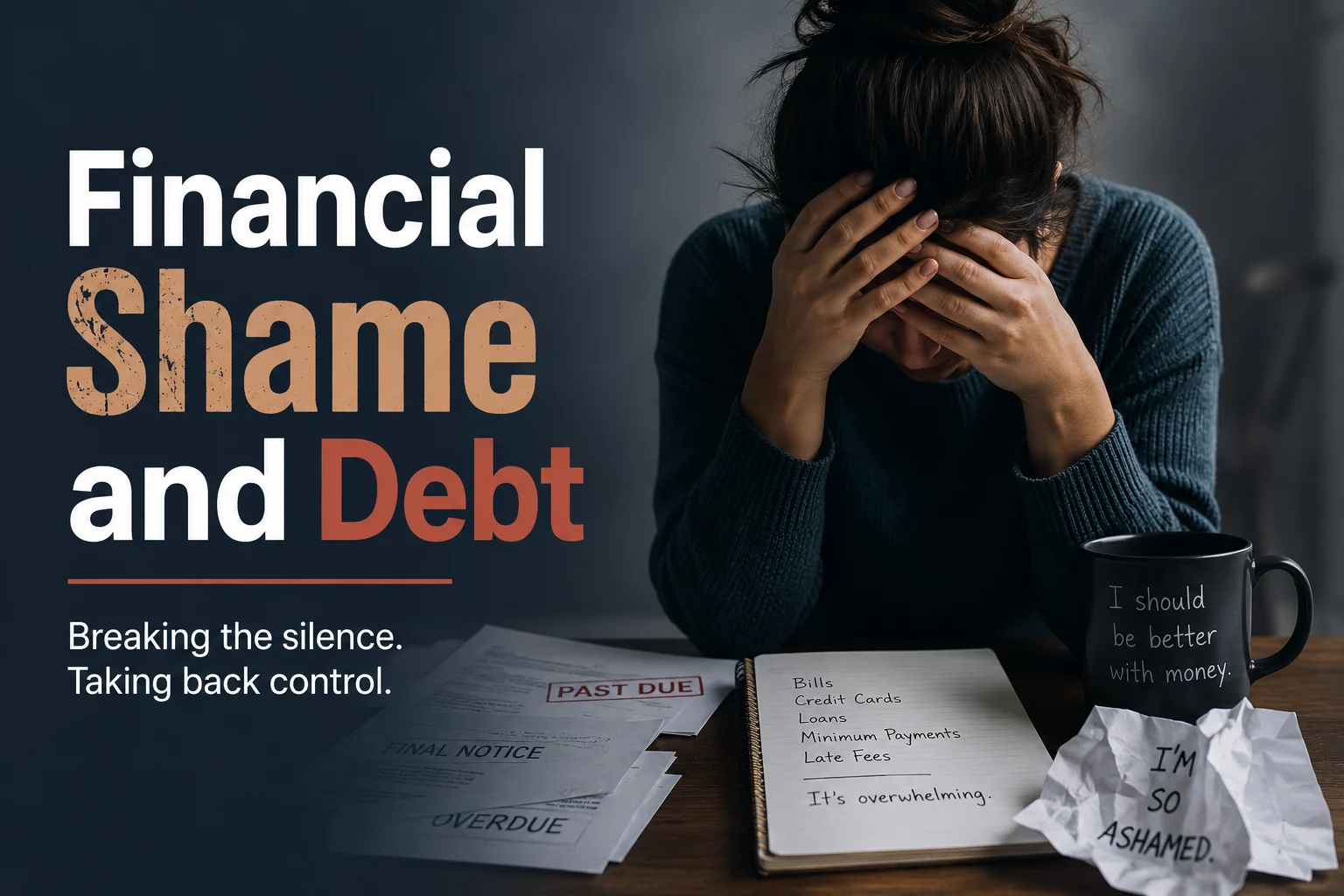
Financial Shame and Debt: Overcoming the Stigma to Take Action
Introduction: The Debt Nobody Talks About
There is a particular kind of silence that surrounds personal debt. It is not the silence of peace — it is the silence of shame.
People who owe money often carry it the way they carry a secret: quietly, heavily, and alone. They smile through family dinners while dreading the bills waiting at home. They celebrate friends’ financial milestones while secretly wondering if they will ever dig themselves out. They avoid phone calls from unknown numbers, lose sleep at 3 a.m., and rehearse excuses for why they cannot join the group vacation, the dinner out, or the birthday celebration.
Debt is not just a financial condition. For millions of people, it is an emotional one — wrapped in shame, guilt, embarrassment, and a profound sense of personal failure.
And here is the cruel irony: that shame — the very feeling that should be motivating action — is often the single biggest reason people do not take action. Financial shame creates paralysis. Paralysis allows debt to grow. Growing debt deepens shame. It is a cycle that can trap people for years, even decades, without a single missed payment ever being the real problem.
This article is about breaking that cycle. It explores the psychology of financial shame, why debt carries such heavy cultural stigma, how that stigma actively makes financial situations worse, and most importantly — the concrete, compassionate steps you can take to move from shame into action, and from action into freedom.
What Is Financial Shame?
Financial shame is the deeply personal, often painful belief that your financial situation is a direct reflection of your worth as a person. It is the internal narrative that says: I am in debt because I am irresponsible. I am broke because I am weak. I cannot manage money because I am stupid.
It is the difference between feeling bad about a situation and feeling bad about yourself because of a situation.
Psychologists distinguish between two related but distinct emotional experiences:
- Guilt says: I did something bad.
- Shame says: I am something bad.
Guilt can be productive. It motivates corrective action. Shame, on the other hand, is corrosive. It attacks identity, not behavior, and because it feels so fundamental and so personal, it tends to produce avoidance rather than engagement.
When people feel guilty about their debt, they might call their creditor and set up a payment plan. When people feel ashamed of their debt, they let the calls go to voicemail and stop opening the mail.
This distinction is not trivial. It has profound consequences for financial behavior — and for mental health.
The Psychology of Money and Shame
Money is not just a financial tool. It is one of the most emotionally loaded topics in human experience. Research in financial psychology consistently shows that people’s relationships with money are deeply entangled with their sense of identity, self-worth, and social belonging.
Money as Moral Currency
In many cultures — particularly in the West — wealth has long been framed as a moral achievement. Prosperity signals hard work, discipline, and virtue. Poverty or debt signals the opposite: laziness, recklessness, or failure of character.
This framing has deep historical roots. Protestant work ethic philosophies, popularized in the 17th and 18th centuries, explicitly linked material success with divine favor and personal virtue. While modern society has moved far beyond such theology, the underlying moral coding of money has proven remarkably persistent. We still carry, often unconsciously, the belief that financially successful people are somehow more deserving — and that financially struggling people have brought it on themselves.
This cultural script means that when someone accumulates debt, they are not just facing a financial problem. They are navigating a perceived moral failure. And that is a much heavier, much more complicated thing to address.
The Brain Under Financial Stress
Neuroscience adds another layer to this picture. Research by Princeton economist Sendhil Mullainathan and Harvard psychologist Eldar Shafir, summarized in their landmark work Scarcity, found that financial stress consumes significant cognitive bandwidth. When people are preoccupied with money worries, they have less mental capacity available for planning, problem-solving, and rational decision-making.
This is not a character flaw. It is a cognitive reality. Financial stress literally impairs thinking, making it harder to do the very things that would improve the financial situation. People in debt are not avoiding action because they do not care. They often avoid it because shame and stress have depleted the mental resources needed to take it.
The Shame-Avoidance Loop
Shame psychologist Dr. Brené Brown, whose research at the University of Houston has shaped modern understanding of shame, identifies three common responses to shame: moving away (withdrawal and hiding), moving toward (people-pleasing and appeasement), and moving against (aggression and blame).
In the context of financial shame, moving away is the most common response. People hide their debt from partners, family, and friends. They avoid opening bank statements. They stop logging into their accounts. They disappear from social situations that might expose the gap between how they appear and how they actually live.
This withdrawal feels protective in the short term, but it is financially catastrophic over time. While you are looking away, interest is accruing, fees are multiplying, and options that might have been available months ago are quietly closing.
Where Financial Shame Comes From
Financial shame does not arise in a vacuum. It is built by culture, family, experience, and the messages we receive about money from the time we are very young.
Family Money Scripts
Financial therapists use the term “money scripts” to describe the beliefs about money that are formed in childhood and carried into adult life — often without conscious awareness. These scripts are absorbed from parents, caregivers, and family dynamics, and they shape attitudes toward earning, spending, saving, and debt.
Common money scripts that feed financial shame include:
- “We don’t talk about money.” — Families that treat money as taboo create adults who feel shame about any financial difficulty because they have no framework or language to process it.
- “Rich people are lucky; poor people are lazy.” — This binary script maps financial status directly to character, setting up shame whenever financial difficulty arises.
- “Debt is a moral failing.” — Some families treat any form of borrowing as shameful, making it nearly impossible to seek help without feeling like a failure.
- “You should always be able to handle things on your own.” — The script of financial self-sufficiency makes asking for help feel like weakness or defeat.
These scripts are not chosen consciously. They are inherited. And because they are so deeply embedded, challenging them requires deliberate, often therapeutic, work.
Social Comparison and Social Media
The digital age has created new and particularly potent sources of financial shame. Social media platforms present carefully curated visions of financial success — the exotic vacations, the new homes, the restaurant dinners, the fashionable wardrobes. What is rarely visible on these platforms is debt, financial anxiety, the car payment that is three months behind, or the credit card balance that has not moved in two years.
This creates a profoundly distorted picture of how people are actually doing financially. Studies show that social comparison is a significant driver of financial stress and shame. When you measure your private financial reality against other people’s public financial performance, the result is almost always unflattering — and unfair.
Research from the American Psychological Association consistently identifies money as the leading source of stress for Americans, but many people experiencing that stress believe they are uniquely struggling. The stigma of debt makes people feel like outliers in a world of financial stability — when in reality, debt is almost universal.
The Cultural Stigma of Bankruptcy and “Failure”
Few financial events carry as much stigma as bankruptcy, debt default, or repossession. These events are treated culturally not as financial circumstances — which they are — but as personal catastrophes, symbols of profound failure, and sources of lasting shame.
This stigma prevents people from using legal financial tools that exist precisely for situations of unmanageable debt. Bankruptcy laws, debt relief programs, and credit counseling services — these are legitimate, legal frameworks designed to help people in financial crisis. Yet many people would rather continue suffering in silence than use them, for fear of how others will judge them.
The shame is costing people options they are legally and morally entitled to.
How Financial Shame Makes Debt Worse
The most important thing to understand about financial shame is that it is not just an emotional burden. It is a financial one. Shame actively worsens debt in measurable, concrete ways:
1. Avoidance Increases the Balance
Every month that a person avoids dealing with their debt, interest charges accumulate. Late fees are added. Penalties kick in. A balance that might have been manageable six months ago becomes overwhelming today — not because the person spent more, but because they looked away.
Avoidance is not neutral. It is expensive.
2. Shame Prevents Help-Seeking
People who are deeply ashamed of their debt are far less likely to seek professional help from credit counselors, financial advisors, nonprofit debt relief agencies, or even trusted friends. Yet help is often the single most effective intervention available.
Many people carry debt for years when a single conversation with a nonprofit credit counselor could have set them on a completely different trajectory. Shame is the barrier between them and that conversation.
3. Shame Leads to Compensatory Spending
This is a counterintuitive but well-documented pattern in financial psychology: people who feel shame about their financial situation sometimes spend more, not less. Retail therapy, impulse purchases, or spending to maintain appearances can all be driven by the emotional pain of financial shame. The temporary relief of a purchase momentarily quiets the shame — and makes the underlying problem worse.
4. Shame Destroys Financial Relationships
Partners who hide debt from each other, family members who borrow without disclosing their full situation, friends who lie about why they cannot participate in social activities — financial shame fractures relationships. And those relationships are often the very support systems that could help.
5. Shame Blocks Future Planning
It is very difficult to plan a financial future when you cannot bear to look honestly at the financial present. Shame makes people avoid budgeting, avoid checking account balances, and avoid engaging with any tool or conversation that would require confronting the truth. Without clear-eyed engagement with reality, no progress is possible.
The Shocking Scale of the Problem
Before anyone can begin to address financial shame, it helps to understand just how common debt actually is. The stigma of debt survives partly because people believe they are unusual in their situation. The data tells a very different story.
- In the United States alone, total consumer debt surpassed $17 trillion in 2023, carried by hundreds of millions of individuals and families.
- More than 45 million Americans carry student loan debt.
- The average American household carries over $6,000 in credit card debt.
- Medical debt is the leading cause of personal bankruptcy in the United States.
- In the United Kingdom, approximately 8.3 million people struggle to pay bills or loan repayments in any given month.
- Across developing economies, including many African, Asian, and Latin American countries, informal debt — borrowed from family, community lenders, or microfinanciers — is an almost universal feature of financial life.
Debt is not a niche condition. It is not the exclusive domain of the reckless or irresponsible. It is a near-universal feature of modern financial life, and the shame that surrounds it is based on a fundamental misreading of reality.
Overcoming Financial Shame: A Step-by-Step Guide
Moving from financial shame to financial action is not a single moment of courage. It is a process — emotional, psychological, and practical. Here is how to navigate it:
Step 1: Name What You Are Feeling
The first and most powerful step in addressing financial shame is to name it — not the debt, but the emotion. Before you open the statement, before you call the creditor, before you make a budget, acknowledge the shame.
Say it to yourself, write it in a journal, or say it to someone you trust: “I feel ashamed of my financial situation. I feel like it reflects badly on me as a person. I feel embarrassed and afraid.”
Naming shame strips away some of its power. Brené Brown’s research consistently shows that shame thrives in secrecy. The moment you bring it into language — even just your own private language — it becomes something you can examine rather than something that controls you.
Step 2: Challenge the Story You Are Telling Yourself
Once you have named the shame, examine the narrative attached to it. What are you actually telling yourself? Are you irresponsible? Stupid? Less worthy than other people? A failure?
Now interrogate that story with facts.
How did the debt actually accumulate? Was it a medical emergency? A job loss? A divorce? An economic downturn? A period of depression that made financial management impossible? A lack of financial education growing up? The predatory practices of a lender? An impossible rent-to-income ratio in an unaffordable city?
Most debt has a story that is far more complicated than personal irresponsibility. Separating the circumstance from your character is not about making excuses — it is about seeing clearly. And you cannot take effective action on a situation you refuse to see clearly.
Step 3: Separate Your Worth from Your Net Worth
Your bank balance is a number. It describes your financial circumstances. It does not describe your intelligence, your creativity, your capacity for love, your work ethic, or your value as a human being. These are not the same thing — and allowing them to become the same thing in your mind is one of the most damaging cognitive distortions that financial shame produces.
Practice this distinction deliberately. Notice when you are measuring your self-worth by your financial worth and consciously correct the narrative. This is not denial — it is accurate thinking.
Step 4: Tell Someone You Trust
Shame cannot survive disclosure. This does not mean announcing your debt on social media or confessing to a room full of colleagues. It means telling one person — a trusted partner, a close friend, a therapist, or a family member — the truth about your financial situation.
The act of disclosure is transformative for several reasons. It ends the exhausting labor of concealment. It creates the possibility of support. It often reveals that the person you told has their own financial struggles they had been hiding. And it establishes a relational accountability that can make taking action feel more possible.
Step 5: Get a Clear Picture of Your Actual Situation
The gap between imagined financial disaster and actual financial situation is often significant — but almost always in one direction: the reality is less frightening than what shame has been telling you.
Shame distorts perception. It makes everything feel enormous, catastrophic, and permanent. A clear-eyed accounting of where you actually are — total debt, interest rates, minimum payments, income, expenses — replaces the vague dread of avoidance with specific, workable facts.
Use a spreadsheet, a notebook, or a debt tracking app. List every debt: the creditor, the balance, the interest rate, and the minimum payment. This exercise, while uncomfortable, is the foundation of every effective debt repayment strategy. You cannot map a route to your destination without knowing where you are starting from.
Step 6: Seek Professional Help Without Shame
There is a persistent misconception that seeking financial help is an admission of defeat. It is not. It is the same logic as seeing a doctor when you are sick or hiring a lawyer when you need legal advice. No reasonable person would suggest you should manage a medical diagnosis alone as a matter of personal pride. Financial difficulty deserves the same compassion.
The resources available are extensive:
- Nonprofit Credit Counseling Agencies — Organizations like the National Foundation for Credit Counseling (NFCC) in the US offer free or low-cost counseling, debt management plans, and financial education. In the UK, StepChange and Citizens Advice offer similar services.
- Financial Therapists — These professionals address both the psychological and practical dimensions of money problems, which is particularly valuable when shame is a significant barrier.
- Debt Relief Programs — Depending on your situation, debt settlement, consolidation, or management plans may be appropriate options.
- Bankruptcy Attorneys — If debt has become truly unmanageable, a bankruptcy consultation (often free or low-cost) can clarify your legal options without judgment.
Seeking help is not a weakness. It is a strategy.
Step 7: Take One Small Action Today
One of the most powerful antidotes to shame is action — not big, dramatic action, but small, concrete steps that interrupt the paralysis.
Today, that might mean:
- Opening one envelope you have been avoiding
- Logging into one account you have not checked in months
- Sending one email to a creditor
- Downloading one budgeting app
- Making one phone call to a credit counseling agency
Small actions rebuild the sense of agency that shame destroys. Each tiny step is evidence that you are not helpless, not hopeless, and not defined by your current financial situation. Stack enough small steps together, and you have built a path forward.
Step 8: Build a Sustainable Repayment Plan
Once you have a clear picture of your debt and have begun addressing the emotional dimension of shame, it is time to build a concrete repayment plan. There are several well-established strategies:
The Debt Snowball Method: Pay minimum payments on all debts, and put every extra dollar toward the smallest balance first. When that is paid off, roll the payment into the next smallest debt. This method generates psychological momentum — each paid-off debt is a concrete win that builds motivation and confidence.
The Debt Avalanche Method: Pay minimum payments on all debts, and direct extra funds to the debt with the highest interest rate first. This method saves the most money over time, though it can feel slower to produce visible results.
Debt Consolidation: If you have multiple high-interest debts, consolidating them into a single lower-interest loan can simplify repayment and reduce total interest costs.
Debt Management Plans (DMPs): Offered by credit counseling agencies, these plans consolidate your debts into a single monthly payment at reduced interest rates, negotiated on your behalf with creditors.
The right strategy depends on your specific situation. What matters most is choosing a plan you can commit to and beginning it.
Step 9: Rebuild Your Relationship with Money
Long-term financial well-being requires more than paying off debt. It requires building a healthier relationship with money — one that is grounded in reality, free from shame, and oriented toward your actual values and goals.
This might involve:
- Financial education — Reading books, taking courses, or working with a financial advisor to build genuine money literacy
- Identifying your money scripts — Working, potentially with a financial therapist, to understand and revise the inherited beliefs about money that drive harmful patterns
- Developing a values-based budget — Designing your spending around what genuinely matters to you, rather than reactive spending driven by stress or shame
- Building an emergency fund — Even a small emergency fund changes your relationship to financial vulnerability, reducing the panic that leads to poor decisions
Step 10: Practice Ongoing Financial Self-Compassion
Self-compassion is not self-indulgence. Research by psychologist Dr. Kristin Neff shows that self-compassion — treating yourself with the same kindness you would offer a struggling friend — produces better outcomes than self-criticism across a wide range of challenging life circumstances, including financial difficulty.
People who respond to financial setbacks with shame and self-criticism are less likely to take corrective action than those who respond with self-compassion and honest problem-solving. Counter-intuitively, being kinder to yourself about your debt may make you more likely — not less — to deal with it effectively.
This means noticing when the inner critic is speaking, interrupting its narrative, and consciously replacing it with the kind of grounded, realistic, compassionate voice you would offer a close friend in the same situation.
What Financial Recovery Actually Looks Like
Financial recovery is not a dramatic, linear transformation. It is unglamorous, incremental, and deeply personal. It looks like:
- Opening the mail, even when it is scary
- Making one payment, even when the full balance feels impossible
- Calling one creditor and being surprised to find they are willing to work with you
- Telling your partner the truth and discovering that the relief is greater than the fear
- Watching your balance decrease by $50 and choosing to celebrate that $50
- Saying no to something you cannot afford without shame, because you know what you are building
It looks like waking up six months from now and realizing you have not lain awake thinking about money in two weeks. It looks like a year from now, being able to look at your accounts without dread. It looks like the gradual, steady return of a sense of financial agency — the belief that your choices matter, that your situation is not fixed, and that the story is not over.
The Conversation We Need to Have
Financial shame is not just a personal problem. It is a social one. The stigma of debt is maintained collectively — by the stories we tell, the topics we avoid, the judgments we make, and the silence we keep.
Changing that culture starts with individual conversations. When someone you know is struggling financially, your response matters. Judgment, unsolicited advice, or dismissive platitudes (“just spend less!”) reinforce shame. Empathy, curiosity, and the willingness to share your own financial realities create something different — connection, normalcy, and the conditions under which people feel safe enough to take action.
Talking openly about money — your mistakes, your debts, your fears, your wins — is a radical act of cultural change. It chips away at the stigma. It reminds people that debt is not a character verdict. It creates space for the honest conversations that make getting help possible.
Final Thoughts: Shame Is Not the Truth About You
If you are reading this while carrying the weight of financial shame, here is what we want you to know clearly and directly: your debt is not the truth about who you are.
It is a set of numbers on a page. Numbers that can be negotiated, restructured, reduced, and ultimately resolved. Numbers that say nothing whatsoever about your intelligence, your character, your worth, or your future.
The shame is real. The pain is real. The exhaustion of hiding and worrying and feeling like you are the only one — that is all real. But none of it is permanent. And none of it is evidence of your inadequacy.
The most courageous financial act is not paying off a million-dollar debt. It is opening the envelope you have been dreading for three months. It is making the phone call. It is telling someone the truth. It is deciding, despite the shame, to look — clearly, compassionately, and honestly — at where you are, so you can begin the work of getting somewhere better.
That work is possible. That work is yours. And it begins the moment you decide that the shame no longer gets to make your financial decisions for you.
Frequently Asked Questions (FAQs)
Q: Is it normal to feel ashamed of being in debt? A: Extremely normal. Studies show that financial stress and shame affect millions of people across all income levels. You are not unusual for feeling this way — but you do not have to stay paralyzed by it.
Q: Can financial shame affect my mental health? A: Yes, significantly. Research links financial stress and shame to anxiety, depression, sleep disorders, relationship conflict, and reduced cognitive function. Addressing the emotional dimension of debt is just as important as addressing the financial one.
Q: How do I tell my partner about hidden debt? A: Choose a calm, private moment. Be honest, specific, and prepared with at least some sense of a plan. Lead with your feelings (“I have been ashamed and afraid to tell you”) rather than launching straight into numbers. Consider seeing a couples therapist or financial counselor together to navigate the conversation constructively.
Q: Where can I get free financial help? A: In the US, the National Foundation for Credit Counseling (NFCC) offers free or low-cost counseling. In the UK, StepChange and Citizens Advice provide free debt support. In Nigeria and other African countries, look for CBN-licensed microfinance institutions and NGO financial counseling programs.
Q: Is bankruptcy something to be ashamed of? A: No. Bankruptcy is a legal financial tool that exists because societies recognize that debt can become genuinely unmanageable through circumstances beyond individual control. It has helped millions of people rebuild their financial lives. Using it when appropriate is not failure — it is a strategy.
Q: How do I stop comparing my finances to others? A: Remember that what you see of others’ finances — especially on social media — is curated and often misleading. Most people are carrying debt you cannot see. Redirect your comparison from others’ apparent wealth to your own progress over time.