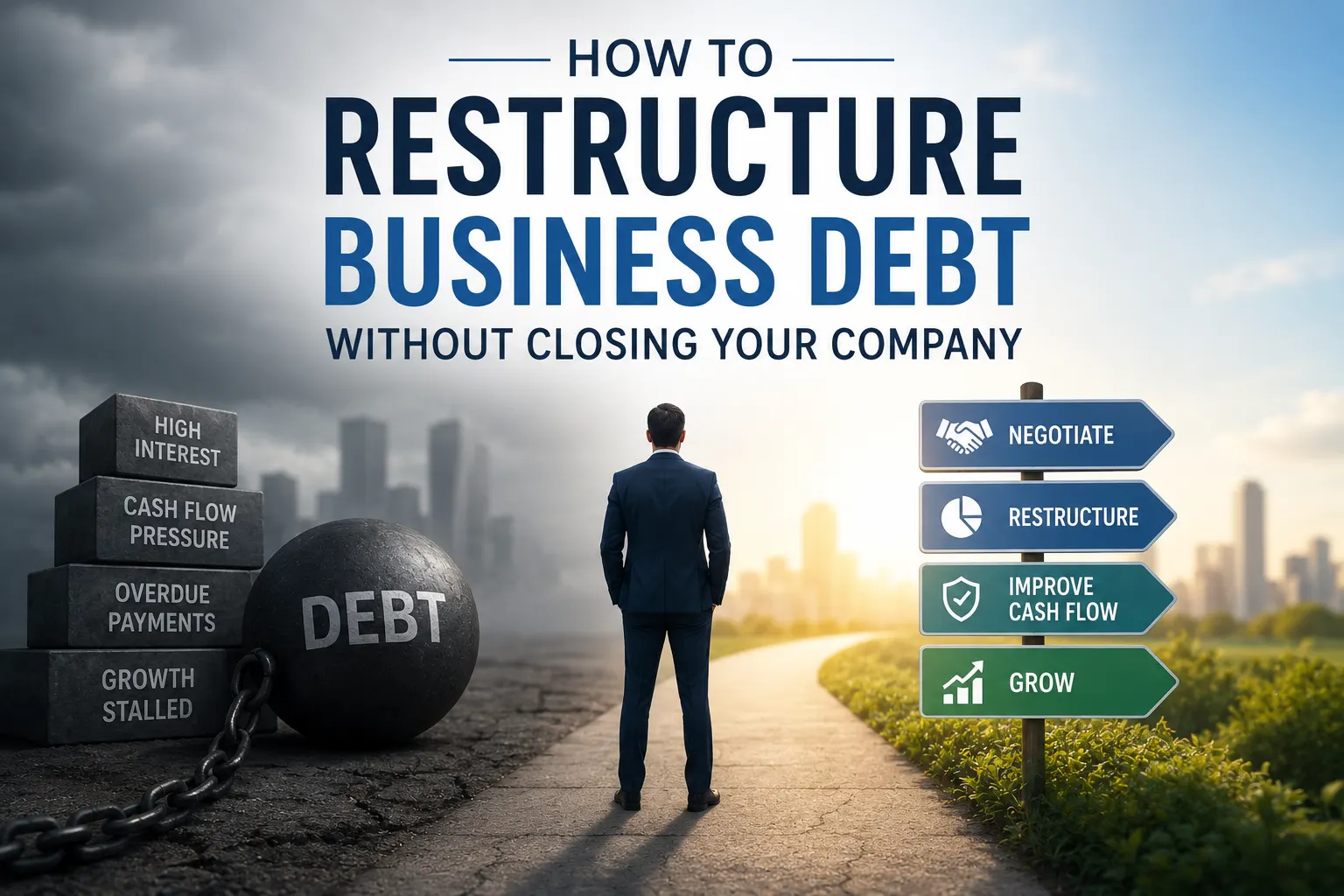
How to Restructure Business Debt Without Closing Your Company
Introduction: Debt Does Not Have to Mean the End of Your Business
Every year, thousands of businesses find themselves in the same terrifying position: revenue has slowed, bills have piled up, creditors are calling, and the weight of debt threatens to crush everything the owner worked so hard to build.
If this sounds familiar, here is what you need to hear first: debt does not automatically mean the death of your business.
Many of the world’s most recognizable companies — from General Motors to Marvel Entertainment to American Airlines — have faced catastrophic debt crises and survived. They did not survive by luck. They survived because their leadership understood one critical concept: debt restructuring.
Business debt restructuring is the process of renegotiating, reorganizing, and modifying the terms of your existing debt obligations so that your company can continue operating, recover its financial footing, and grow again. Done correctly, it can reduce your monthly payments, lower your interest rates, extend your repayment timelines, and in some cases, reduce the total amount you owe.
This guide is your comprehensive roadmap to restructuring your business debt without closing your company. We will walk through the types of business debt, the warning signs that restructuring is needed, every major restructuring strategy available, how to negotiate with creditors, and the legal tools at your disposal — all without assuming you have a financial degree or a team of corporate lawyers.
Understanding Business Debt: What Are You Actually Dealing With?
Before you can restructure your debt, you need to have a clear, complete picture of what you owe. Business debt typically falls into several categories, and the restructuring options available to you will often depend on what type of debt is causing the problem.
Secured Business Debt
Secured debt is backed by collateral — an asset your lender can seize if you default. Common examples include:
- Commercial mortgages (backed by your business property)
- Equipment financing (backed by the equipment itself)
- Business vehicle loans (backed by fleet vehicles)
- SBA loans with collateral requirements
Secured debt is often easier to restructure because the lender has a tangible asset they want to avoid repossessing. In many cases, they would rather negotiate new terms than deal with the legal costs and losses associated with seizing and selling your assets.
Unsecured Business Debt
Unsecured debt has no collateral attached. If you default, the creditor cannot immediately seize an asset — they must sue you first. Common examples include:
- Business credit cards
- Lines of credit
- Supplier and vendor invoices
- Some personal guarantees on business accounts
While unsecured creditors have less leverage in default situations, they can still do significant damage — destroying your business credit, pursuing legal judgments, and disrupting your supplier relationships.
Trade Debt
Trade debt refers to money owed to your suppliers and vendors for goods and services already delivered. This is one of the most negotiable forms of debt because suppliers typically want to preserve the business relationship rather than destroy it.
Tax Debt
Tax debt owed to the IRS or state/local authorities is among the most serious forms of business debt. It accrues penalties and interest rapidly and can result in liens, levies, and asset seizure. However, even the IRS has formal programs to help struggling businesses restructure tax obligations.
Warning Signs Your Business Needs Debt Restructuring Now
Debt restructuring is most effective when done proactively — before the situation becomes a full-blown crisis. Here are the key warning signs that your business needs to take action:
- You are consistently using credit to pay operating expenses (payroll, utilities, rent) rather than growth investments.
- Your debt service ratio is above 1.25, meaning more than 80% of your operating income is going toward debt payments.
- Creditors or suppliers are threatening legal action or have already filed claims.
- You have missed or delayed payments on loans, leases, or invoices more than once in the past year.
- Your business credit score has dropped significantly, restricting your ability to access new financing.
- You cannot meet your current payroll or are regularly late paying employees.
- Cash flow projections show insolvency within 6 to 12 months at the current rate.
If two or more of these describe your situation, debt restructuring is not just an option — it is a necessity.
Step 1: Conduct a Full Financial Audit Before Anything Else
The most common mistake business owners make when facing debt problems is jumping straight into crisis mode — calling creditors, cutting staff, or making panicked financial decisions — without first getting a complete picture of where they stand.
Before you restructure anything, you need a thorough financial audit that covers:
- A complete debt inventory — List every debt, including the creditor name, total balance, interest rate, monthly payment, due dates, whether it is secured or unsecured, and whether any personal guarantees are attached.
- A cash flow statement — Document every source of income and every expense over the past 6 to 12 months. Identify which months were profitable and which were not, and why.
- A balance sheet review — Compare your total assets against your total liabilities. If liabilities significantly exceed assets, you are technically insolvent, which changes the urgency and strategy of your restructuring.
- A revenue forecast — Is your revenue declining, flat, or growing? Restructuring only makes sense if the underlying business has a viable future. If the business model itself is broken, restructuring debt is just delaying the inevitable.
- Identification of core vs. non-core assets — Are there assets you could sell to reduce debt load? Equipment, real estate, intellectual property, or non-essential business divisions may provide immediate cash relief.
This audit gives you the ammunition you need to negotiate credibly and strategically with creditors and advisors.
Step 2: Hire the Right Professional Help
Business debt restructuring is not a DIY project for most owners. The stakes are too high and the legal, tax, and financial complexities too significant to navigate alone. Depending on your situation, you may need one or more of the following professionals:
Business Debt Restructuring Advisor or Turnaround Consultant
These specialists work specifically with distressed businesses to develop and execute restructuring plans. They have established relationships with lenders, understand the full range of restructuring options, and can often negotiate significantly better terms than business owners can on their own.
Certified Public Accountant (CPA) or CFO
An experienced CPA or fractional CFO can help you restructure your financial statements, identify tax implications of debt forgiveness, and present your financials to creditors in the most favorable light.
Business Bankruptcy Attorney
Even if you are not planning to file for bankruptcy, a bankruptcy attorney understands the legal landscape of debt restructuring deeply. Their involvement in negotiations signals to creditors that you are serious — and that bankruptcy is a real alternative if they refuse to cooperate.
Small Business Development Center (SBDC)
SBDCs, funded in part by the U.S. Small Business Administration, offer free or low-cost consulting to small business owners. They can help you assess your situation, prepare financial documents, and connect you with appropriate resources.
Step 3: Explore Informal Debt Restructuring Options First
Informal restructuring means negotiating directly with your creditors outside of any formal legal process. It is faster, cheaper, and less damaging to your business reputation than formal or legal restructuring. For many businesses, informal restructuring is all that is needed.
Loan Modification or Forbearance Agreement
Contact your lenders directly and request a loan modification. You can ask for:
- A temporary payment reduction or deferment (forbearance) while your cash flow recovers
- An extension of the loan term to reduce monthly payments (e.g., extending a 5-year loan to 10 years)
- An interest rate reduction, especially if market rates have dropped since you took the loan
- Conversion of variable-rate debt to fixed-rate debt for more predictable payments
Lenders generally prefer these modifications over defaults. They would rather receive modified payments than absorb the losses associated with a business default or bankruptcy.
Debt Consolidation
If you have multiple high-interest business debts, consolidating them into a single loan with a lower interest rate can dramatically reduce your monthly payment burden. This does not reduce what you owe in total, but it simplifies your payments and can free up significant monthly cash flow.
Options include:
- SBA 7(a) loans, which can be used to refinance existing business debt at favorable rates
- Bank term loans at lower rates
- Alternative lenders, such as online business lenders, though these often carry higher rates than banks
Vendor and Supplier Payment Plans
Your suppliers and vendors are some of the most flexible creditors you will encounter. They have a vested interest in keeping your business alive because your survival means continued future sales to them.
Approach your key suppliers openly and honestly. Explain your situation and propose a structured repayment plan for outstanding invoices — for example, paying overdue balances in installments over 6 to 12 months while continuing to pay current invoices on time.
Most suppliers will agree to reasonable terms rather than risk losing a long-term customer or pursuing legal action that could result in them recovering only pennies on the dollar.
Debt Settlement
In some cases, especially with unsecured creditors, you may be able to negotiate a lump-sum settlement for less than the full balance owed. If a creditor believes your business may go bankrupt and they will recover nothing, they may accept 40–70 cents on the dollar as a full and final settlement.
Debt settlement should be approached carefully, as it can have tax implications (forgiven debt may be treated as taxable income) and can damage your business credit. It works best when you have a lump sum available — perhaps from a business asset sale or an investor — and the creditor’s alternative is receiving nothing.
Step 4: Utilize Formal Debt Restructuring Through Bankruptcy Protection
If informal negotiations fail or your debt load is too severe for negotiation alone, formal restructuring through the bankruptcy system may be your best option. Critically, bankruptcy does not always mean closing your business. For businesses, it can be a powerful restructuring tool.
Chapter 11 Bankruptcy: Reorganization, Not Liquidation
Chapter 11 bankruptcy is specifically designed to allow businesses to restructure their debts while continuing to operate. It is the most powerful formal restructuring tool available.
Under Chapter 11:
- An automatic stay immediately halts all creditor collection actions — no more lawsuits, garnishments, or foreclosures while the process is underway.
- You operate as a “debtor in possession,” meaning you retain control of your business operations during the process.
- You develop a reorganization plan that proposes how you will repay creditors over time — often at reduced amounts.
- Creditors vote on the plan, and if approved by the court, it becomes legally binding on all creditors, even those who voted against it.
Chapter 11 is expensive and complex — legal fees can run into the hundreds of thousands of dollars for large cases — but it is extraordinarily powerful for businesses with substantial assets and operations worth preserving.
Subchapter V: A Streamlined Option for Small Businesses
Since 2020, small businesses with debts under $7.5 million have had access to Subchapter V of Chapter 11, a significantly simplified and less expensive version of the Chapter 11 process. It is faster, requires less court oversight, and dramatically reduces legal costs — making formal restructuring accessible to small and mid-sized businesses for the first time.
Chapter 13 for Sole Proprietors
If your business is structured as a sole proprietorship, Chapter 13 bankruptcy allows you to restructure both business and personal debts simultaneously through a 3 to 5-year repayment plan. Your assets are protected from liquidation as long as you comply with the plan.
Step 5: Address Tax Debt Strategically
Business tax debt requires special attention because the IRS and state tax authorities have collection powers that other creditors do not — including the ability to levy bank accounts and seize assets with relatively little court involvement.
IRS Offer in Compromise (OIC)
An Offer in Compromise allows qualifying businesses to settle their tax debt for less than the full amount owed. The IRS evaluates your ability to pay, your income, your expenses, and your asset equity before accepting or rejecting an offer. While acceptance rates are low without professional help, a qualified tax attorney or enrolled agent can significantly improve your chances.
IRS Installment Agreement
If you cannot pay your tax debt in full, the IRS will typically agree to a structured installment payment plan. Penalties and interest continue to accrue, but the agreement halts collection actions as long as you make payments on time.
Currently Not Collectible Status
In cases of genuine financial hardship, the IRS can declare a business’s account Currently Not Collectible (CNC), temporarily suspending all collection activity. This does not eliminate the debt, but it buys critical time for a business to stabilize its finances.
Step 6: Cut Costs and Generate Cash Flow in Parallel
Restructuring your debt obligations only solves half the problem. The other half is ensuring that your business generates enough cash flow to meet its restructured obligations and avoid falling back into the same cycle.
During and after restructuring, focus aggressively on:
Cutting non-essential expenses. Review every line item in your budget. Cancel subscriptions, renegotiate lease terms, reduce inventory levels, and eliminate any expense that does not directly generate revenue or support core operations.
Accelerating receivables. If customers owe you money, collect it faster. Offer early-payment discounts, tighten payment terms, and follow up on overdue invoices immediately. Consider invoice factoring — selling your receivables to a third party at a discount — for immediate cash injection.
Monetizing underutilized assets. Are there pieces of equipment sitting idle? Unused real estate? Excess inventory? Converting these to cash not only reduces debt but also eliminates the ongoing costs of maintaining those assets.
Diversifying revenue streams. If your business relies heavily on one client, one product, or one market, a single disruption can trigger a debt crisis. During your restructuring period, actively pursue new revenue opportunities that reduce concentration risk.
Step 7: Rebuild Business Credit After Restructuring
Surviving a debt restructuring leaves marks on your business credit profile. The work is not done when your debts are restructured — you must now actively rebuild your creditworthiness so that your business can access affordable capital in the future.
Key steps include:
- Open a secured business credit card and pay it in full every month to begin re-establishing a positive payment history.
- Monitor your business credit reports with Dun & Bradstreet, Experian Business, and Equifax Business regularly for errors or outdated information.
- Pay all current obligations on time, without exception. Even one late payment during the recovery period can significantly set back your rebuilding efforts.
- Work with vendors who report to business credit bureaus so that your on-time payments are recorded and boost your score.
- Gradually apply for new credit as your profile improves, starting with small limits and building over time.
Rebuilding business credit typically takes 1 to 3 years after a significant restructuring event, depending on the severity of the original damage and the consistency of your recovery efforts.
Real-World Examples of Successful Business Debt Restructuring
Marvel Entertainment
In 1996, Marvel Entertainment filed for Chapter 11 bankruptcy with over $600 million in debt. Rather than liquidating, the company restructured, emerged from bankruptcy in 1998, and went on to build the most successful entertainment franchise in film history. The Marvel Cinematic Universe — which has generated over $30 billion in box office revenue — would not exist without successful debt restructuring.
A Local Restaurant Chain
A family-owned restaurant chain with 8 locations accumulated $2.3 million in debt during the pandemic. Instead of closing, the owners hired a turnaround consultant, negotiated deferred rent agreements with all 8 landlords, converted supplier debt into 18-month payment plans, secured a Subchapter V restructuring for their largest loans, and reduced their menu to cut food costs by 31%. Two years later, the chain was profitable and had reopened a ninth location.
Common Mistakes to Avoid During Business Debt Restructuring
- Waiting too long to act. The earlier you begin restructuring, the more options you have. Many businesses wait until they are in full crisis before seeking help, dramatically limiting their choices.
- Hiding the truth from creditors. Attempting to mislead creditors about your financial situation destroys trust and can have legal consequences. Transparency — handled strategically with professional guidance — almost always produces better outcomes.
- Ignoring personal guarantees. Many small business owners have personally guaranteed business debts. Failing to account for these during restructuring can expose your personal assets even after the business stabilizes.
- Restructuring without fixing the underlying problem. Debt restructuring gives your business breathing room. But if the core business model, leadership, cost structure, or market strategy remains broken, restructuring is only a temporary delay.
- Going it alone. The legal, financial, and negotiation complexity of debt restructuring almost always requires professional expertise. The cost of good advice is far less than the cost of a restructuring gone wrong.
Conclusion: Your Business Has Options — Use Them
Facing serious business debt is one of the most stressful experiences an entrepreneur can endure. The pressure from creditors, the weight of responsibility for employees and stakeholders, and the fear of losing what you have built can feel paralyzing.
But the message of this guide is clear: you have more options than you think.
From informal negotiations with lenders and suppliers, to formal bankruptcy protection under Chapter 11, to targeted strategies for tax debt and credit rebuilding — the toolkit for business debt restructuring is extensive. Businesses far deeper in debt than yours have restructured, recovered, and gone on to thrive.
The path forward requires honesty about your situation, professional guidance, disciplined execution, and an unwavering commitment to the long-term survival and success of your company.
Start today. Conduct your financial audit. Make that first call. Because the cost of inaction is always greater than the cost of restructuring — and the window to act effectively does not stay open forever.