What a Game of Checkers in 1951 Can Teach You About AI
The same principles that taught a computer to play checkers now power an AI trading system that could transform your portfolio
Editor’s Note: Artificial intelligence: it isn’t just changing technology. It’s transforming the world around us – including how markets work.
That’s why I’m excited to feature an article today from Keith Kaplan, CEO of TradeSmith, who’s leading an ambitious effort to apply real AI to trading. Keith’s team has built a “Super AI” that analyzes thousands of stocks in real time, identifying the five highest-conviction trades in the market with up to 85% accuracy.
It’s a fascinating look at how machine learning is giving investors an edge that once belonged only to Wall Street’s elite.
Keith will reveal exactly how it works – and how you can see it in action – during The Super AI Trading Event, which you can still stream on replay for a limited time.
Read on for Keith’s full breakdown – and catch the event before it goes offline.
In the University of Manchester’s Computing Machine Laboratory, a new Ferranti Mark I computer hums behind rows of valves and whirring tape drives.
It’s 1951. And the Ferranti Mark I is Britain’s first commercial electronic computer – a two-ton mass of vacuum tubes, magnetic drums, and paper-tape readers.
At the console sits Christopher Strachey, a schoolteacher and an amateur programmer.
He’s written the code for a simple game of checkers. At first, the machine plays terribly, losing every match.
Then Strachey adds one more feature: instructions telling the computer to record which moves led to a win and which to a loss, and to adjust its play accordingly.
Game by game, the Ferranti begins to avoid bad moves, repeat good ones, and show the faintest hint of judgment.
By morning, it can play a decent game – something no computer had ever done before.
For the first time, a machine wasn’t merely following orders. It was improving from experience.
For the first time in history, a machine hasn’t just executed instructions – it has learned from experience.
Today, machine learning powers everything from self-driving cars to drug discovery, language translation, climate modeling, and advanced robotics.
It’s writing code, designing chips, diagnosing cancers, even composing symphonies.
It’s also transforming how we invest.
For decades, elite hedge funds like Renaissance Technologies, Citadel, and Two Sigma have relied on machine-learning systems to stack the odds in their favor. It’s been a cozy cartel. But this week, my team and I at TradeSmith unveiled a new “Super AI” trading program available to regular investors.
You may have heard of it by now.
Using a simple five-stock portfolio, we’ve shown how you could have used it to make an average annual gain of 374% over the past five years… and a 602% gain last year alone.
And in 2020, the worst year in our backtest and the year that saw global economies shuttered due the pandemic, it returned 238%.
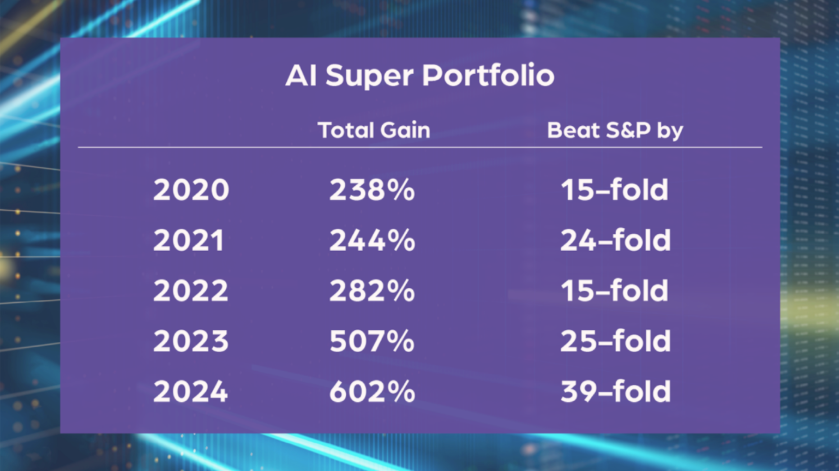
If you haven’t already, make sure to catch the replay of the live demo of this portfolio. I go into a lot more detail on how these returns are possible.
Today, I’ll show you more of how it works… and how it helps levels the playing field with Wall Street.
First, if you don’t know us already, some background on TradeSmith.
AI Trading Systems Once Reserved for Wall Street, Now for Everyone
As CEO, I manage a team of 74 researchers and developers and an $8 million annual budget to create world-class software tools and analytics.
We’ve built tools to help investors track portfolios, manage risk, spot seasonality patterns in stocks, and generate regular income in the options market, along with a suite of world-class market analytics.
Today, we help 134,000 people in 86 countries track $29 billion. Forbes, The Wall Street Journal, and The Economist have profiled our breakthroughs.
Above all, we pride ourselves on being ahead of the pack…
Even before ChatGPT burst onto the scene in November 2022, we were focused on harnessing AI to give our customers a sharper edge.
In 2023, we launched our first AI-powered trading model, Predictive Alpha. Every day, this AI projects the price action for 2,334 stocks up to 21 trading days in advance.
For some stocks, the price hits our projection more than 90% of the time.
And we consistently see accuracy above 70%. That includes more than 700,000 projections a month since the model launched.
And when we’ve traded single-stock projections using this system, the results have been remarkable.
On July 27, 2023, our model predicted that Opendoor (OPEN) would soon hit a price of $4.87.
The stock hit that price just 24 hours later. And my team booked a 9.4% gain on that pick.
Annualized, that’s the equivalent of growing your money 34 times in a year.
And you could have boosted that gain to 244% in just 24 hours with a special kind of trade.
Or take restaurant chain Wingstop (WING). On June 4, our AI projected a 74% probability of the stock rising over the next 21 days to $384.87.
Wingstop reached that price within 24 hours of our recommendation – delivering a 3.6% gain in a single day, which you could have boosted to 156% in the same time span.
Then, this past May, our model predicted Tesla (TSLA) would hit $302.89 within 21 trading days.
It reached that price even faster than expected. We booked a 5.2% gain in 24 hours, which could have been boosted to 310% using the same kind of trade.
But my team and I wanted to make this technology even more accessible – and even more powerful.
So, we created a breakthrough we call The AI Super Portfolio.
How a Five-Stock AI Portfolio Could Redefine Investing Success
It holds five stock positions based on our AI’s projections. Then you rotate into a new set of five when the AI says it’s time to sell.
That’s it.
We designed it to be simple to use. But despite this simplicity – or maybe because of it – it’s extremely powerful.
As I mentioned earlier, this strategy could have produced an average annual gain of 374% in a recent five-year study.
No guesswork. No chasing headlines. Just a repeatable process grounded in data, discipline, and extensive testing.
It’s the clearest proof yet that AI isn’t just changing investing – it’s redefining what’s possible for individual investors.
AI levels the playing field between the hedge fund elites and everyday investors. And TradeSmith is proud to pioneer this type of trading, bringing it directly to you and our fellow subscribers.
The Next Phase of the AI Investing Revolution
If you missed Wednesday’s event, you can still catch the replay here.
You’ll see how this technology is helping Main Street investors claim the same advantages hedge funds have enjoyed for decades.
I also get into more detail on how the system works… the results it’s produced in our testing… and why I believe systems like these will soon put financial advisors out of work.
Even if you don’t join us in our AI trading revolution, I urge you not to skip the event either way.
A significant change is coming to the markets on October 22. It has nothing to do with the government shutdown, tariffs, the Fed, or anything you’ll find at the top of The Wall Street Journal.
Nonetheless, it will affect you. And our team has prepared a 100% free trade recommendation that we believe will help you navigate what’s coming.
We sent out the first live five-stock recommendations from our “Super AI” on Thursday morning at 7:30 a.m. Eastern Time.
But don’t worry… our algorithm rotates the portfolio regularly. So, there’ll be plenty of fresh recommendations coming soon.
Go here now to watch the replay before it’s gone.