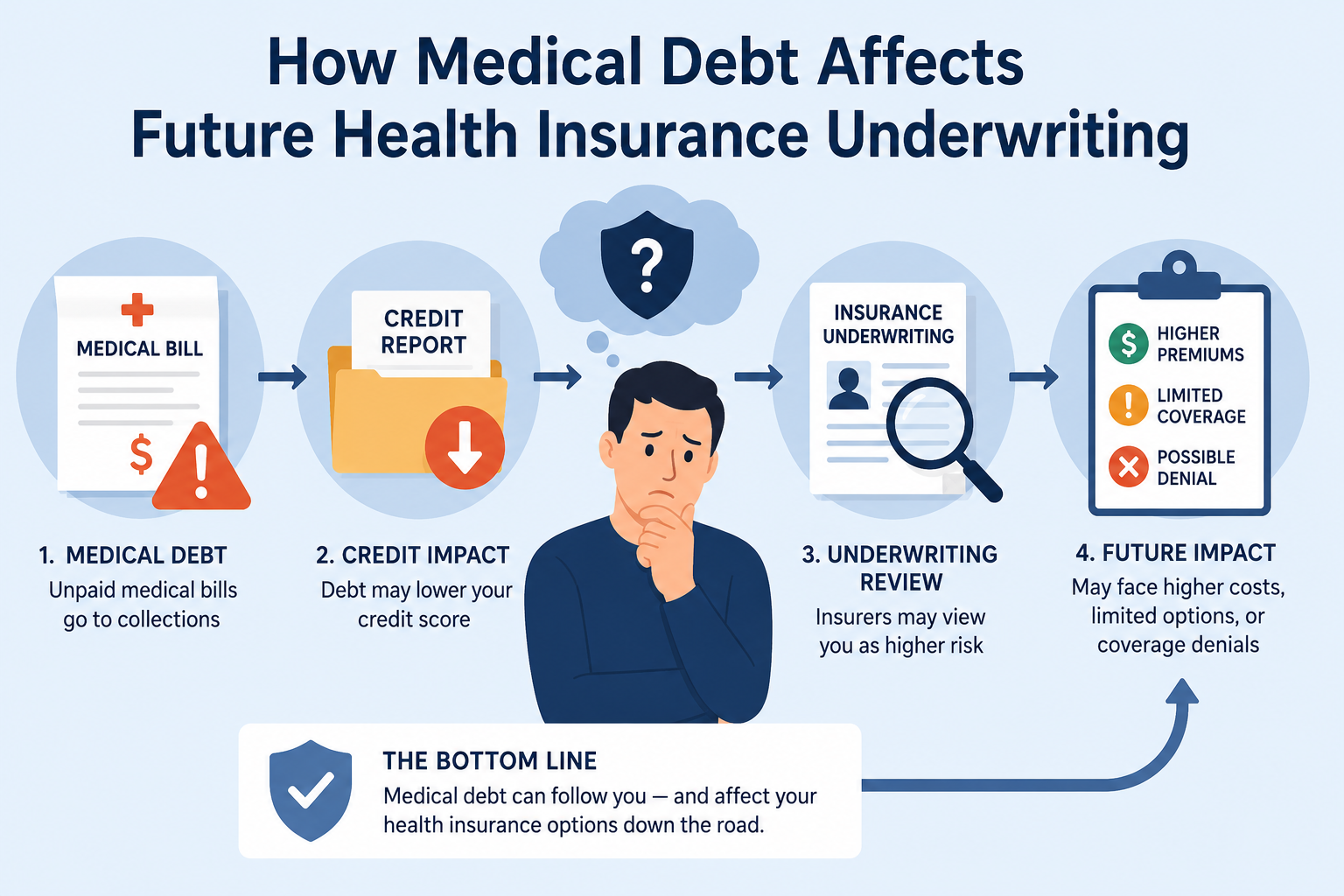
How Medical Debt Affects Future Health Insurance Underwriting
Getting a large medical bill is stressful enough without wondering whether it will come back to haunt you the next time you apply for insurance. It’s a reasonable fear — before 2010, health insurers built entire underwriting departments around exactly this kind of information. But the rules have changed dramatically, and in 2026 the honest answer is more nuanced than “yes” or “no.” Medical debt itself is largely walled off from health insurance underwriting, but it can still brush up against other types of coverage, other financial products, and other decisions insurers make about you. This article breaks down exactly where the line is drawn, where it’s blurry, and what you can do to protect yourself either way.
Quick Answer
For ACA-compliant major medical health insurance, medical debt cannot be used to deny you coverage, raise your premium, or exclude your condition. This is federal law, and it applies whether you buy through the Marketplace, get coverage through an employer, or qualify for Medicaid. However, medical debt can still indirectly affect you in a few important ways:
- It can appear on your credit report, which insurers use for other lines of coverage (auto, home, sometimes life)
- It can affect your life, disability, or long-term care insurance applications, which are medically underwritten and not protected by the ACA
- It can influence short-term and limited-benefit health plans, which fall outside ACA protections
- It can show up during employer group underwriting in rare edge cases
- It can affect your broader financial profile in ways that limit which plans you can realistically afford, even if they can’t deny you outright
1. What “Underwriting” Actually Means in Health Insurance
Underwriting is the process an insurer uses to decide two things: whether to offer you coverage at all, and what to charge you for it. Historically, health insurance underwriting worked a lot like life insurance underwriting still does today — insurers asked about your medical history, sometimes required a physical exam or blood work, and used that information to either deny coverage, exclude specific conditions, or charge a higher premium (called a “rating up” or “surcharge”).
Before 2014, this meant that having a chronic illness, a past surgery, or even a manageable condition like asthma could result in denial, exclusion riders, or premiums that were effectively unaffordable. Medical debt was part of that picture too, since insurers sometimes viewed a history of large unpaid medical bills as a proxy for poor health, high future claims risk, or both.
The Affordable Care Act changed the underwriting model for one specific category of insurance: ACA-compliant major medical health insurance. It did not change the rules for every other type of insurance product that touches your health or your wallet. Understanding which bucket a given policy falls into is the key to understanding whether your medical debt is relevant.
2. Why ACA Plans Can’t Use Medical Debt Against You
Three ACA provisions work together to protect you from medical-debt-based discrimination in major medical coverage:
Guaranteed issue. Under the Affordable Care Act, all health insurance policies must be sold on a guaranteed issue basis, meaning insurers cannot deny you a policy because of your health status, medical history, or financial history related to health, including unpaid medical bills.
Community rating. Insurers cannot charge higher premiums based on health status, and premiums can only vary by age, location, and tobacco use. There’s no line item on a Marketplace application asking about outstanding medical debt, and even if there were, insurers legally cannot factor it into your premium.
No pre-existing condition exclusions. Insurers cannot deny claims for treatment of pre-existing conditions, and a pre-existing condition is defined broadly as any condition present before enrollment, regardless of whether you received a formal diagnosis, sought medical advice, or underwent treatment for it.
This means that if your medical debt originated from, say, a cancer diagnosis, a car accident, or a chronic condition, none of that history can be used against you when you apply for a Marketplace plan, an ACA-compliant off-exchange plan, or most employer-sponsored group plans. All coverage is guaranteed issue regardless of health history, and there is no pre-existing condition waiting period.
It’s worth pausing on how significant this protection actually is. According to KFF Health Policy, approximately 54 million non-elderly adults — about 27% of the U.S. adult population under 65 — have a pre-existing condition that would have resulted in denial or premium loading under pre-ACA underwriting rules. For anyone in that group, the ACA isn’t a technicality — it’s the reason they can get coverage at all.
What ACA plans genuinely cannot do
- Ask about your medical debt on an application
- Deny you coverage because you have unpaid hospital bills
- Charge you more because a collections agency has your account
- Exclude coverage for the condition that caused the debt in the first place
- Impose a waiting period before covering a pre-existing condition
What ACA rules do NOT cover
- Life insurance
- Disability insurance
- Long-term care insurance
- Short-term health plans
- Health care sharing ministries
- Some grandfathered plans that predate 2010
- Credit decisions unrelated to health coverage (mortgages, auto loans, credit cards)
The ACA only applies to health insurance. Life insurance, disability insurance, and long-term care insurance can still deny you coverage or charge higher premiums based on your health history. These products are not covered by the ACA protections. This is the crux of the issue, and it’s where most people get confused — “health insurance” in casual conversation often gets stretched to cover several product categories that are regulated completely differently.
3. Where Medical Debt Still Matters: Life, Disability, and LTC Insurance
This is the part of the underwriting world where medical debt — and more importantly, the medical history behind it — remains fully relevant.
Life insurance
When you apply for a life insurance policy above a certain size (commonly $100,000–$250,000, though thresholds vary by carrier), you’ll typically go through full medical underwriting: a health questionnaire, a review of your prescription history through databases insurers subscribe to, sometimes a paramedical exam, and a check with the Medical Information Bureau (MIB), a database that member insurers use to share coded medical history on applicants.
Medical debt itself isn’t reported to the MIB — it’s not a credit bureau. But the underlying diagnosis or treatment that generated the debt absolutely is fair game. If you have $40,000 in medical debt from a cardiac event, the life insurer isn’t looking at the debt figure; it’s looking at the cardiac event, your treatment plan, your prognosis, and your current health markers. The debt is simply a footprint that sometimes leads an underwriter, or a savvy insurance agent, to ask follow-up questions, toward information they’re already entitled to evaluate.
Disability insurance
Disability insurers are arguably the most sensitive to medical debt as a signal, because unpaid medical bills related to a chronic or recurring condition can indicate a higher likelihood of future claims. Disability underwriting typically involves detailed health questionnaires, an Attending Physician Statement from your doctor, and sometimes a review of your financial situation to confirm the coverage amount is reasonable relative to your income. A pattern of medical debt tied to an ongoing condition can result in an exclusion rider (the specific condition is excluded from coverage), a higher premium, or in some cases a decline.
Long-term care insurance
LTC insurance is the most heavily underwritten personal insurance product on the market, precisely because insurers are pricing in a real possibility of expensive, extended future claims. Applicants in their 50s and 60s with existing chronic conditions — and the medical debt that sometimes accompanies them — face some of the strictest underwriting standards in the industry, including cognitive screenings, in-person assessments, and full medical record pulls.
Why this distinction matters for your content strategy
If you’re advising readers who conflate “health insurance” with “any insurance that touches health,” the biggest service you can do is separate ACA major medical (protected) from life/disability/LTC (not protected). This is also the single most common point of reader confusion in this niche, and search intent data reflects it — people search “does medical debt affect my insurance” expecting a yes/no answer that doesn’t actually exist until you specify which product.
4. Medical Debt, Credit Reports, and Insurance Scores
Even though health insurers can’t use your credit report or medical debt in underwriting, other insurance lines — auto and homeowners insurance in most states — use a credit-based insurance score, a specialized score derived from your credit report that predicts the likelihood you’ll file a claim. This is legal in most states (California, Hawaii, and Massachusetts are notable exceptions that restrict or ban the practice).
Here’s where medical debt’s relationship with credit reporting becomes important, and where the rules have shifted substantially over the past three years.
The rule that almost banned medical debt from credit reports
In January 2025, the CFPB finalized a rule that would have prohibited credit bureaus from including most medical debt on consumer credit reports and barred creditors from using medical debt information in credit decisions. The rule’s key provisions included removing medical collections under $500 from credit reports and preventing medical debt from being used in credit decisions by lenders using reports that include medical information.
That rule never fully took effect. On July 11, 2025, the U.S. District Court for the Eastern District of Texas vacated the CFPB’s rule prohibiting the inclusion of medical debt on consumer credit reports, and the court also concluded that the Fair Credit Reporting Act expressly preempts state laws that attempt to impose similar restrictions. As of mid-2026, the reasoning was that the FCRA explicitly allows creditors to use properly coded medical debt information in credit decisions, and an agency can’t prohibit what Congress expressly permitted. There is no federal ban on medical debt appearing on credit reports.
What’s still protecting consumers
Even without the federal rule, voluntary industry changes made by the three major credit bureaus in 2022–2023 remain in effect as of mid-2026:
- Paid medical collections have been removed from credit reports regardless of the original amount
- Medical debts under $500 have been removed regardless of whether they’re paid or unpaid
- Medical debts less than one year old are not reported, after the bureaus extended the original waiting period from six months to twelve months
But these are voluntary industry practices, not laws — these changes are industry decisions, not laws, and the bureaus could reverse them at any time. That’s an important nuance for anyone advising readers: the current protection is real, but it’s fragile, and it rests on the bureaus’ continued willingness to maintain it rather than a binding statute.
State-level protections are patchy
There has been strong recent activity by states to adopt medical debt credit reporting bans, with nine of the fifteen recent state statutes going into effect in 2025 or January 1, 2026. But the same court ruling that vacated the federal rule cast doubt on these state laws too — the court’s decision to vacate the rule nationwide also included dicta suggesting FCRA preemption of similar state statutes, though the National Consumer Law Center has pushed back, arguing that this preemption language has no direct impact on state laws since the issue wasn’t actually before the court, and that the ruling’s relief struck down only the CFPB’s rule, not any state law.
Practically speaking, this means your protection against medical debt appearing on a credit report — and therefore feeding into an auto or home insurance score — now depends heavily on which state you live in, and even that protection is being actively contested in court.
The bottom line for insurance scores
If your medical debt has been reported to a credit bureau (because it’s over $500, more than a year old, and unpaid), it can lower your credit score, and in most states that lower score can translate into a higher credit-based insurance score for auto or home coverage — completely separate from any health insurance underwriting.
5. Short-Term and Limited-Benefit Plans: The Exception That Still Bites
Short-term health insurance plans, healthcare sharing ministries, and some limited-benefit or fixed-indemnity plans are not required to follow ACA rules. Losing employer-sponsored coverage, aging off a parent’s plan, and becoming newly eligible for marketplace subsidies all create special enrollment rights for ACA coverage, but people who miss open enrollment and don’t qualify for a special enrollment period sometimes turn to these non-ACA products as a stopgap — and that’s exactly where medical underwriting resurfaces.
Short-term plans, health sharing ministries, and some grandfathered plans may not be required to follow ACA rules, and applicants can be excluded, charged more, or denied coverage based on health history. If your medical debt is tied to a chronic or recurring condition, a short-term plan underwriter can ask about it directly, and depending on state rules, can decline you or exclude the related condition entirely.
This is a meaningful gap for content coverage, since a lot of readers who search “medical debt and health insurance” are specifically worried about this scenario — often because they’re between jobs, self-employed, or waiting out an enrollment window.
6. Employer Group Coverage and Medical Debt
Employer-sponsored group health plans are also required to follow guaranteed issue and no-pre-existing-condition-exclusion rules under both HIPAA and the ACA. Under HIPAA and the ACA, employer group plans cannot exclude pre-existing conditions, and employees are protected regardless of how long they’ve been at their new job.
There is one edge case worth flagging: employer-offered voluntary benefits like supplemental life insurance, critical illness insurance, or accident insurance above a guaranteed-issue threshold sometimes require “evidence of insurability,” which functions like a mini life-insurance underwriting process. If your medical debt is tied to a condition you’d have to disclose on that questionnaire, it can affect approval for that specific voluntary benefit — even though your core group medical plan remains fully protected.
7. Medicare, Medigap, and Medical Debt
Original Medicare (Parts A and B) has no medical underwriting at all — eligibility is based on age or disability status, not health history or debt. Medicare Advantage plans are also guaranteed issue during your initial enrollment period.
Medigap (Medicare Supplement) policies are where underwriting can reappear. If you’re applying for a Medigap policy outside your initial 6-month open enrollment window (the period that starts when you’re 65 and enrolled in Part B) or outside a guaranteed-issue “trial right” scenario, insurers in most states can medically underwrite you, ask about your health history, and use it to deny coverage or charge more. Medical debt tied to a chronic condition can indirectly matter here in the same way it does for life and disability insurance — not as a debt figure, but as a marker of the underlying health event.
8. The Indirect Ways Medical Debt Still Follows You
Even where medical debt can’t legally be used in underwriting, it can still shape your insurance situation indirectly:
It limits what you can afford. Even a fully guaranteed-issue ACA plan has premiums, deductibles, and copays. Someone carrying significant medical debt may be pushed toward the cheapest available plan (often a Bronze-tier plan with a high deductible), not because they were denied better coverage, but because their overall financial strain narrows their real-world options.
It affects mortgage and loan underwriting, which indirectly affects insurance bundling. Auto and home insurers frequently offer bundled discounts, and a lower credit-based insurance score from reported medical debt can reduce the value of those bundles.
It can surface during life insurance interviews even when not directly asked. Underwriters sometimes ask applicants to explain gaps in employment, financial stress, or bankruptcy filings, and a debt collection history related to a major medical event can come up organically in that conversation even if “do you have medical debt” isn’t a listed question.
It can affect eligibility for premium tax credits indirectly. This isn’t underwriting, but it’s a related financial consequence worth mentioning: your Marketplace subsidy eligibility is based on income, and if medical debt is affecting decisions like which job to take or whether to reduce work hours for a caregiving situation, it can indirectly shift your subsidy tier.
9. Real Numbers: How Big Is the Medical Debt Problem?
- An estimated 15 million Americans had medical collections on their credit reports before the 2022–2023 voluntary bureau changes took effect.
- Approximately 54 million non-elderly U.S. adults — about 27% of the under-65 population — have a pre-existing condition that would have triggered denial or premium loading under pre-ACA underwriting rules.
- Under the current voluntary bureau policy, any single medical collection account under $500 is excluded from credit reports regardless of payment status, and any medical collection over that threshold is excluded once paid.
- The reporting waiting period for an unpaid medical collection is now 12 months from the original delinquency, up from 6 months previously — giving patients a full year to resolve billing disputes or work out payment arrangements with a provider before it can appear on a report.
Example: Two people, two very different outcomes
Person A has $8,000 in medical debt from an emergency appendectomy, currently unpaid and 14 months old. She applies for an ACA Marketplace plan during open enrollment. Her application asks nothing about medical debt or health history. She’s approved at the community-rated premium for her age and location, identical to a neighbor with no medical debt at all.
Person B has the same $8,000 in medical debt from the same kind of procedure, but applies for a $500,000 term life insurance policy six months later. The life insurer’s questionnaire asks about major surgeries in the past two years. Person B discloses the appendectomy. The underwriter pulls records, confirms full recovery with no complications, and issues the policy at standard rates — but if the underlying event had been something like a partially treated chronic condition instead of a resolved acute one, the outcome could have included a premium rating or exclusion rider.
Same debt amount, completely different underwriting exposure — because the product, not the debt, determines the rules.
10. How to Protect Yourself Before You Apply for Coverage
- Know which product you’re applying for. ACA major medical (Marketplace, most employer plans, Medicaid) — you’re protected. Life, disability, LTC, short-term plans, or Medigap outside your guaranteed-issue window — you’re not.
- Check your credit report before applying for anything credit-scored. Dispute any medical collection under $500, already paid, or under 12 months old — these should not appear under current bureau policy.
- Negotiate or settle medical debt where possible, since a paid medical collection is removed from credit reports regardless of amount under the current voluntary bureau policy.
- Get everything in writing if you’re negotiating a payment plan directly with a provider, since this can sometimes prevent the account from ever reaching a collection agency and being reported at all.
- Time major life or disability insurance applications carefully. If you’re recovering from a medical event, ask an independent agent when underwriters typically consider a condition “resolved” for rating purposes — this varies significantly by condition and carrier.
- Don’t assume all agents or plans are ACA-compliant. Before answering health questions on any application, confirm whether you’re looking at a Marketplace/ACA plan or a short-term/limited-benefit product.
- Check your state’s specific protections, since the legal landscape around medical debt and credit reporting is currently unsettled and varies by state.
11. Comparison Table: Which Insurance Types Can Use Medical Debt or Health History?
| Insurance Type | Medical Underwriting Allowed? | Can Deny for Pre-Existing Condition? | Medical Debt Directly Relevant? |
| ACA Marketplace / individual health plan | No | No | No |
| Employer group health plan | No | No | No |
| Medicaid | No | No | No |
| Original Medicare (Parts A & B) | No | No | No |
| Medicare Advantage (initial enrollment) | No | No | No |
| Medigap (outside guaranteed-issue window) | Yes, in most states | Yes, in most states | Indirectly, via disclosed health history |
| Short-term health plans | Yes | Yes | Indirectly, via disclosed health history |
| Health care sharing ministries | Yes (informal) | Often, informally | Indirectly |
| Life insurance (above guaranteed-issue amount) | Yes | Yes, via rating/exclusion | Indirectly, via MIB and disclosed history |
| Disability insurance | Yes | Yes | Indirectly, sometimes directly asked |
| Long-term care insurance | Yes, extensively | Yes | Indirectly |
| Auto/home insurance (credit-based score) | No medical underwriting, but credit-based scoring | N/A | Yes, if reported to credit bureau |
12. Frequently Asked Questions
Can a health insurance company deny me coverage because of unpaid medical bills? No. If it’s an ACA-compliant plan — Marketplace, most employer plans, or Medicaid — guaranteed issue rules prohibit denial based on medical debt or health history of any kind.
Will medical debt raise my health insurance premium? No, for ACA-compliant plans. Premiums can only vary by age, location, tobacco use, and plan tier — not by health status or financial history.
Does medical debt show up when I apply for life insurance? The debt itself typically doesn’t appear directly, but the medical event that caused it can come up through health questionnaires, prescription database checks, or Medical Information Bureau records, and that history is fair game for life insurance underwriting.
Is medical debt still on my credit report in 2026? It can be, depending on the amount, age, and payment status. As of mid-2026, there’s no federal ban, but paid medical collections and any collection under $500 are still voluntarily excluded by the three major credit bureaus, and unpaid collections aren’t reported until 12 months past delinquency.
Can medical debt affect my auto or home insurance rates? Potentially, yes — in most states, auto and home insurers use credit-based insurance scores, and a medical collection that’s reported to a credit bureau can lower that score.
Does paying off medical debt help my future insurance applications? For ACA health coverage, it makes no difference either way since medical debt isn’t part of the equation. For credit-scored insurance products (auto, home) and for your general credit profile, paying it off can help, since paid medical collections are currently excluded from credit reports regardless of amount.
What if I can’t afford my medical debt and I’m about to apply for health insurance? Apply anyway. ACA-compliant plans cannot ask about or use medical debt in the decision. Focus your debt resolution efforts separately, through negotiation, payment plans, or other debt relief options, without worrying it will affect your health coverage eligibility.